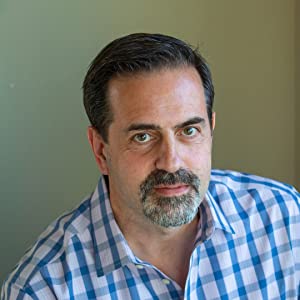
It’s my pleasure to introduce to you Micah Thorp, who may soon become your new favorite author. As his Amazon page tells us “Micah L. Thorp is a physician and writer in Milwaukie, Oregon, who lives with his wife, three teenage boys and an overly self-assured dog. He loves taking care of patients, participating in clinical research, and writing fiction and non-fiction stories. A lifelong Oregonian, he grew up in the shadow of the timber industry, a waning 1960s counterculture, and Ken Kesey.”
Will: From your Amazon author page, we see you’ve been writing fiction and nonfiction for many years, but Uncle Joe’s Muse looks like the first novel you’ve written since Operation Honeybee, a medical thriller, back in 2005. And now you’re about to publish a sequel, Uncle Joe’s Senpai. What lured you back into writing novels?
Micah: I wrote Operation Honeybee when I was in a medical school. I was doing a rotation on the Omaha Reservation in Nebraska and had a lot of down time at night with very little to do. One of the great things about the act of writing is you don’t need much other than time and something to write with to engage in it. A few months later I’d finished my rotation and a novel.
Shortly after I returned, I started residency and had little time to do anything other than work. Starting a career and raising kids kept me busy for a couple decades.
About five or six years ago my wife suggested I go to a writer’s workshop. I enjoyed it enough I went to another, then another. After a couple years I realized I’d written enough to begin formulating a second novel.
Will: You’re a physician—a nephrologist—who’s written about medical research as well as about the sometimes laugh-out-loud antics of Uncle Joe’s Band, a group of four aging metal heads. Is writing a passion for you? A Yin and Yang thing: science and art?
Micah: Exactly. Most of the research I’ve been a part of involved the epidemiology of kidney disease and/or predictive analytics. The writing necessitated by research is pretty much the opposite of creative writing – it’s done in a very structured manner in a group, and the important part of it usually isn’t the prose. It’s creative in its own way, but very different. Writing grants and research papers is done mostly by committee, which can suck the life out of even the most creative soul. I love research, it’s invigorating to be the first to uncover something, but the process can be laborious.
In contrast, my approach to creative writing is very unstructured, at least at the outset. The generation of ideas is a pretty fluid and somewhat random process. I’ll write a whole bunch over a week or two and then nothing for a period of time. For me, the structured part of creative writing (and really the important part) is putting all the disparate pieces together into a coherent narrative. It’s something I’m still learning to do.
Will: Can you tell us a bit about your writer’s journey? When did you realize you were a writer? What about your process? Do you have a special time and place for writing?
Micah: I don’t really think of myself as a writer. I find writing is something of an outlet – it’s not therapy, but it is therapeutic. I don’t write every day, nor do I have a special time or place where I write. I write whenever the muse strikes, which can be both quite inconvenient and hard to accommodate, but I find in those periods I produce my most interesting work.
I would add that the process of writing doesn’t always involve “the writing”. Reading other writers’ works, editing and jotting down random ideas are all part of the process as well.
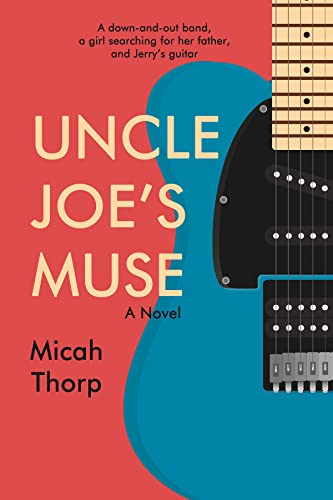
Will: What was your inspiration for Uncle Joe’s Muse? I’ve described it as “Dave Barry’s Lunatics meet Forrest Gump.” How would you describe it?
Micah: I grew up outside of Eugene Oregon, which was a bit of a countercultural hotbed, during the 1980s. I’d drive by Ken Kesey’s family farm every so often and go to a Grateful Dead show every summer. Somewhere along the line the idea of writing about the accidental adventures of a wandering Deadhead seemed a natural narrative for a story.
The other part of the story was built around the members of an aged garage band trying to make it. I’m pretty sure everyone knows one or two of those groups – bands with more optimism than talent.
I wanted to write something about fatherhood as well. The idea that a group of men are suddenly forced to deal with a teenage daughter was another great way to explore the concept.
Will: Uncle Joe’s Senpai is due for publication in June. Most of it is set in Japan, and it sounds as though you have a true love for that country. Can you tell us about Japan and give us a peek at the new novel?
Micah: When my kids were small and my wife began looking at nearby schools, we found Richmond Elementary, part of the Japanese language immersion program in the Portland Public School system. From kindergarten until they left high school, our boys (and to an extent their parents) became versed in Japanese culture. We’ve traveled to Japan on a couple occasions and had the opportunity to participate in some of the local Japanese culture.
As with any cultural experience, the big overarching differences are intellectually interesting, but it’s the discovery of the little nuances that make it fun. In Uncle Joe’s Senpai, I include lots of these: the ubiquitous Japanese vending machines, wildly entertaining game shows, digitalized toilets and so on. There are a few situations I included which were based on real events – one involving a frog, another involving an ashtray. It’s the stuff you remember when you think about a people and a place.
Will: Do you have any advice you would give aspiring authors? Are there pitfalls along the way? Are there any things they should pursue and others they should avoid?
Micah: One of the hardest things to manage as an artist (the problem extends far beyond writing) is what to do with criticism. Criticism, good and bad, can be a gift – if you learn what to do with it. Some criticism is meaningful and will point out strengths and weakness you can hone or mitigate. Other criticism is salacious and not worth listening to. The trick is figuring out which is which. My advice – hear or read all of it but consider carefully whether it can provide useful guidance before changing what you’ve created. Don’t make any changes right away and evaluate the changes you do make carefully before you decide to keep them.
Will: Thank you so much, Micah, for sharing your time, energy, and insights with us. I’ve included a link to Uncle Joe’s Muse below, and encourage my readers to grab a copy now. It’s a perfect accompaniment to that cocktail by the pool! And be sure to look for Uncle Joe’s Senpai when it reaches Amazon’s shelves.
 William J. Cook