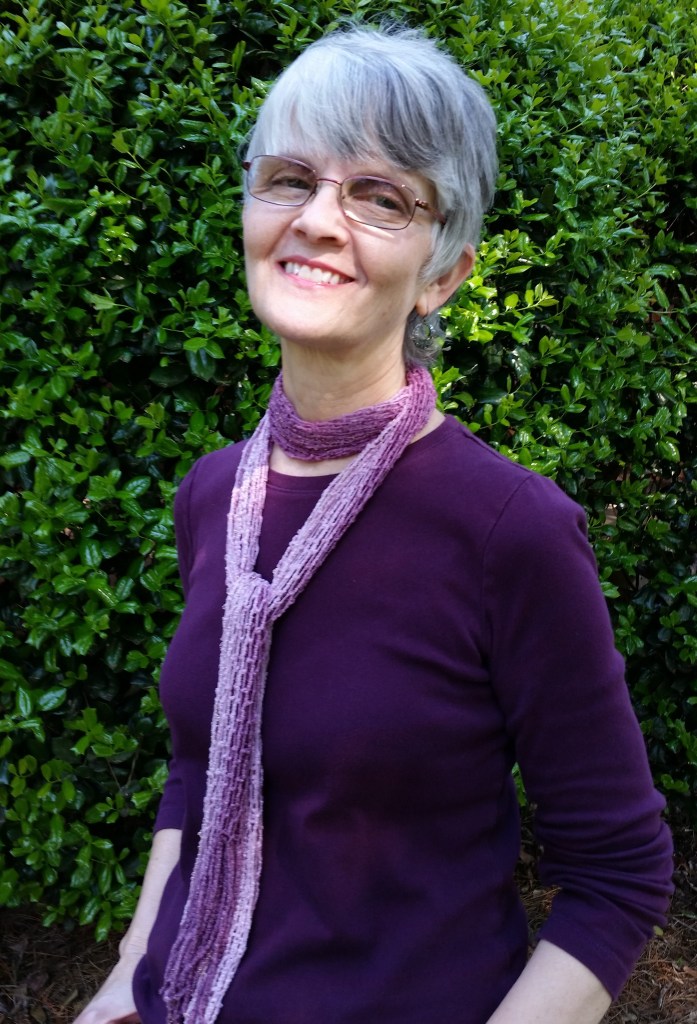
An Interview With Indie Author Connie Lacy

Connie worked for many years as a radio reporter and news anchor, with a couple of brief forays into TV news along the way. Her experience as a journalist shows up in some of her novels. She also dabbled in acting in college and community theater. She uses those experiences in some of her books as well.

Her novels are fast-paced stories featuring young women facing serious challenges set against the backdrop of some thorny issues. She writes time travel, magical realism, historical fiction and climate fiction – all with a dollop of romance.​

Bill: Connie, how and why did you become a writer, and can you tell us about your creative process?

Connie: When I was in 5th grade, I read The Little House series of books by Laura Ingalls Wilder. I decided I should be a writer too. I started with my biography. After filling a page and a half, I couldn’t think of anything else to say. Ha!  I transitioned into writing angsty, teenaged poetry, then switched to short stories at 15, tried writing children’s books, YA novels, and eventually settled on writing adult novels. My creative process involves channeling my concerns about a variety of issues, including social injustice, personal failures and climate change. To shine a light on a topic, I use it as a backdrop for my story. Racial injustice is featured in several of my books—A Daffodil for Angie (Young Adult) The Time Capsule,and The Going Back Portal. Then I work on building a main character to inhabit that world. I get to know her first, then outline a story arc for her. That changes sometimes as she interacts with other characters. But I always know how the story will end before I begin writing. My first draft always stinks. It’s messy, inconsistent and redundant. I go through many, many re-writes. The revision process always generates better ideas for scenes, and in my forthcoming novel, created a different ending. That’s the first time that’s happened.

Bill: Time travel figures in several of your novels, but not in a science fiction kind of way. Talk about that.

Connie: I’ve always liked time travel stories. Ideas pop into my mind. The Time Telephone grew out of this exact thought: what if you could call someone in the past on a time telephone? The novel also grew out of a situation within my extended family where a parent abandoned their child. So I combined the two—writing about a teenage girl grieving her mother’s death, lamenting the fact that even when her mother was alive, they never had a real mother-daughter relationship. There’s that element of fantasy, but it also deals with the very real-world issue of child abandonment. In The Going Back Portal, a young woman’s grandmother appears to be descending into Alzheimer’s disease, talking about a Cherokee Indian woman living in the woods behind her country cottage. But it turns out there’s actually a time gate that leads the protagonist to 1840 where a Cherokee woman is struggling to survive the brute who’s taken control of her land and her life. The novel delves into the wrongs perpetrated against Native Americans. That’s what appeals to me – not the sci-fi type of time travel story.

Bill: Would you describe several other of your books?

Connie: My concern about climate change prompted me to write a trilogy set a hundred years in the future against a backdrop of runaway global warming. I wanted the story to be romantic and exciting. So I mixed all of that together to produce The Shade Ring Trilogy—The Shade Ring, Albedo Effect, and Aerosol Sky. My novel, VisionSight,        is about a young woman who can see the future, including the unexpected challenges that “gift” brings. The novel I’m publishing this fall is another time travel story. This one is set in the 1850s and features a suffragette living with an abolitionist family in the Philadelphia area.

Bill: You just finished producing your own audiobook version of The Time Capsule. What was that like for you?

Connie: In a word: EXHAUSTING! I worked in radio news for many years. With all my experience in front of the mic and my experience editing, I foolishly thought “How hard can it be?” I was humbled by how hard it can be. Delivering the news is nothing like narrating a novel. There are character voices to do. Even if you don’t want to get too carried away, you still have to differentiate between characters. Of course, the sheer length of the novel is a big factor. The audiobook version of The Time Capsule is 9 hours and 21 minutes! Agh! Then there’s mouth noise to deal with. Multiple takes of every paragraph to hopefully get a usable take, often editing a sentence from one take into another paragraph take. The editing was a fulltime job. And don’t forget the technical issues, including hiss and extraneous noises (airplanes flying overhead,

barking dogs, etc.) I had to get up at 4:00 a.m., go down to the basement to my makeshift recording booth so I could record for a couple of hours before all the noise started. Will I ever do another audiobook? I’m still pondering that question.

Bill: What advice would you give to other indie authors?

Connie: There are lots of blog posts and newsletters out there with specific advice on publishing, plotting, character development, pacing, etc. I don’t want to get into all of that. I think a good piece of advice is to read a lot. Read the kinds of books you want to write. Notice what the good authors do—how they transition, how they handle dialog, how they develop character. Think about those things when you notice them and imagine how you might adapt those techniques in your own writing. It can also be educational to read poorly written books, although not as enjoyable. In that case, you might notice things you, yourself, never want to do—like using a character’s name

over and over and over and over when he/she, him/her would be better.

Thanks for having me, Bill. BTW—here’s my website.

A note to my readers: My interview with Connie first appeared in my October Newsletter. If you haven’t subscribed yet, here’s the link. I promise it’s spam-free, and I will not clutter your inbox!


A New Book Review

I am truly excited, and the image above is a picture of my head exploding! Diane Donovan of Donovan’s Literary Services and the Midwest Book Review has just sent me her review of Before Our House Fell into the Ocean, and it’s so amazing I have to post the whole thing here. Here’s what she had to say:

Before Our House Fell Into the Ocean: Stories of Love and Death is a literary collection of short works that each center on a bizarre character’s dilemma. It is highly recommended for literature readers seeking outside-the-box representations and scenarios.

Take “Bad Seed,” for example. Here, a depressed husband faces a fed-up wife who is tired of his attitude and ongoing regrets over “the biggest failure of his life,” and who walks away from the seminary and the priesthood to become a psychotherapist and husband.

What she doesn’t know is that the demons of the past and the decision that causes him to hear voices and suffer are alive and well in the present. A visit to the source of this haunting reveals its roots. It also provides the narrator with a different choice.

William J. Cook writes these descriptive lives with an attention to description and detail that draws readers into each life: “The dragon cannot be slain, only kept at bay. A deep weariness washes over my body and soul, like a receding tide sweeping debris from the beach.”

Belief, vows, faith, and Church enter many of these works, which also offer astute psychological inspections from diverse perspectives. One example lies in “Coffee,” in which a zombie longs not for flesh, but coffee made by the “sorceress of coffee” barista Suzie, who has a special gift. The sense of humor over Joey’s dilemmas as a zombie comes to life: “Nobody wants to date a zombie. And nobody wants to stay married to one, either. Righteous types call us the New Lepers.”

The ironies of experiences which move into the territories of acquittal, social dilemma, and psychological transformation contribute to writings which are compellingly unique.

Before Our House Fell Into the Ocean is a collection designed for the literary thinker.

Its inspections and haunting stories of souls on fire in different ways will find a home in any literary collection, and in the hearts and minds of readers who enjoy twists of plot that leave them thinking.

Pre-Order Sale!

The countdown is underway! On September 30 the Kindle version will be released, and I feel that my generous supporters need something back. I’ve just reduced the regular $3.99 price to $0.99, and Amazon assures me that anyone who pre-ordered at the regular price will be billed at the new sale price instead. (Whew! That spares me the task of having to track down early buyers and give each of them $3.00 back!) If you haven’t already purchased it, please take advantage of the sale here. If you’re a “hard copy” fan who craves the feel and smell of paper, here’s the link to the paperback. BTW—any of you who live locally, I would be more than happy to make a “house call” and come to your home to sign your copy!

On other fronts, my audiobook narrator Joel Zak has submitted the “retail sample” of D&D to ACX for evaluation. If it passes muster, he will proceed full-bore with recording the Driftwood Mystery. Here’s another BTW—for fans of that book, there is an epilogue in the new book of short stories. I couldn’t help myself!

And may I say a few words about being an indie author and trying to market your books? I don’t mean to be a whiner, but it’s freakin’ hard! Truth is, when you publish on Amazon, unless you’re already famous, you’re a needle in a humongous haystack. I’m posting on Instagram and Facebook, taking out ads on Amazon and BookBub, but have yet to create any “buzz.” If you’re a fan of my writing, I don’t think you’ll be disappointed with the new book. And if you’d care to share that with your friends, I would be truly grateful.

Until next time.

Paperback Published!

I am happy to announce that the paperback edition of my new book of short stories has been released today and is available for sale on Amazon. Here’s a link. The digital version is still on target for publication on September 30 and you can pre-order it here

Meanwhile, work proceeds on the audiobook production of Dungeness and Dragons, with a tentative release date around December-January. Fingers crossed!

I will begin work on my October Newsletter soon. It will feature an interview with Connie Lacy, an independent author in Georgia who can really spin a tale. You don’t want to miss it. If you haven’t yet signed up for my monthly newsletter, please do so here.

Talk to you soon!

.

Why Read Short Stories?

“A short story is the ultimate close-up magic trick—a couple thousand words to take you around the universe or break your heart.” –Neil Gaiman.

Many people have said things to me such as, “I don’t like reading short stories. I need the depth and the character development that happens in a novel.” Although I can certainly appreciate that, my response is usually something like, “Although I really enjoy a filet mignon Oscar or seared Ahi tuna entrée, that doesn’t stop me from enjoying the canapés! Munching a bit of caviar on a dollop of crème fraiche, with a bit of hard-boiled egg and green onion, is a marvelous way to sip champagne!”

So it’s more a matter of “both/and” rather than “either/or.” Each form of writing brings its own special pleasures. Who can argue against falling headlong into another world in a novel that simply transports us countries or planets or galaxies away? How can we not revel in getting to know a character so thoroughly that he or she becomes a living, breathing person who haunts our sleeping and waking moments?

But what about that fine painting or photograph hanging on your wall—the one that captures the light or the emotion or the mind-set of that special day you’ll never forget? A good short story is like that. It gives us a tantalizing glimpse into that other world, seizing a moment in time to which we may return again and again. The mysterious stranger with whom we locked eyes at a party, the extraordinary sunrise that redeemed a sleepless night, the brief but sweet kiss that lingers on the lips—such is the short story.

As a writer, the short story is a way to “cleanse my palate” between forays into novel-writing. It’s my attempt at legerdemain—not a cheap parlor trick but true sleight-of-hand. Can I convince you of the reality of these protagonists and their struggles in ten pages? Can I startle you with an ending you didn’t see coming? Can I provoke a laugh or a tear in the time it takes you to brew your morning coffee?

I found writing my new collection of short stories to be immensely rewarding. I hope reading them will be equally pleasurable for you.

You can pre-order the Kindle version here. It will be released on September 30. The paperback edition will also be published soon.

A New Book Review

Joe Kilgore of The US Review of Books has just reviewed my soon-to-be-published collection, Before Our House Fell into the Ocean: Stories of Love and Death. The review is so positive and I’m so blown away by it that I just had to post the whole thing here!

Before Our House Fell into the Ocean: Stories of Love and Death
by William J. Cook

book review by Joe Kilgore
“You never recover from grief, you make an uneasy truce with it. You find a shelf to put it on so it doesn’t bleed into every thought or conversation.”

This collection, as the subtitle states, is constructed around love and death. Hemingway reminds us that “all stories, if continued far enough, eventually end in death, and he is no true-story teller who would keep that from you.” Author Cook is a “true-story teller,” even though his tales are fiction, and death is not necessarily the end of his stories but the fulcrum on which they often turn. Cook’s stories also remind us that while death can certainly wound love, it can never truly erase it.

The differences in the collection’s stories are many. A house does fall into the sea, but the memories inside it are not lost. A boy with a tragically disfigured face is empowered by a girl who sees more than his scars. A romance blooms in a carnival midway, where the tawdry glitter hides unimaginable pain. A man suffering a horribly debilitating disease discovers he’s not as alone as he thinks he is. A priest grapples with questions not only of loss, grief, and death but perhaps with the hardest questions of all, those about life.

Cook is a writer who is able to convey pathos without wallowing in sentimentality. He wields his pen like a scalpel, intricately cutting to the heart of remorse without opening veins of self-pity. There is a sturdy sense of acceptance in the way his characters look sorrow in the eye and deal with it. Humor is never completely absent, even in tales where one doesn’t necessarily expect it. There are a dozen stories within the covers of this book, all imminently readable. What stands out the most, however, is the author’s commitment to understanding and compassion. They are the foundational pillars on which this literate and life-affirming collection stands.

RECOMMENDED by the US Review

OK, gang. With an endorsement like that, I think you should pre-order a copy! Just click on the image above and it will be delivered to your Kindle bright and early on the morning of September 30.

The New Book Cover

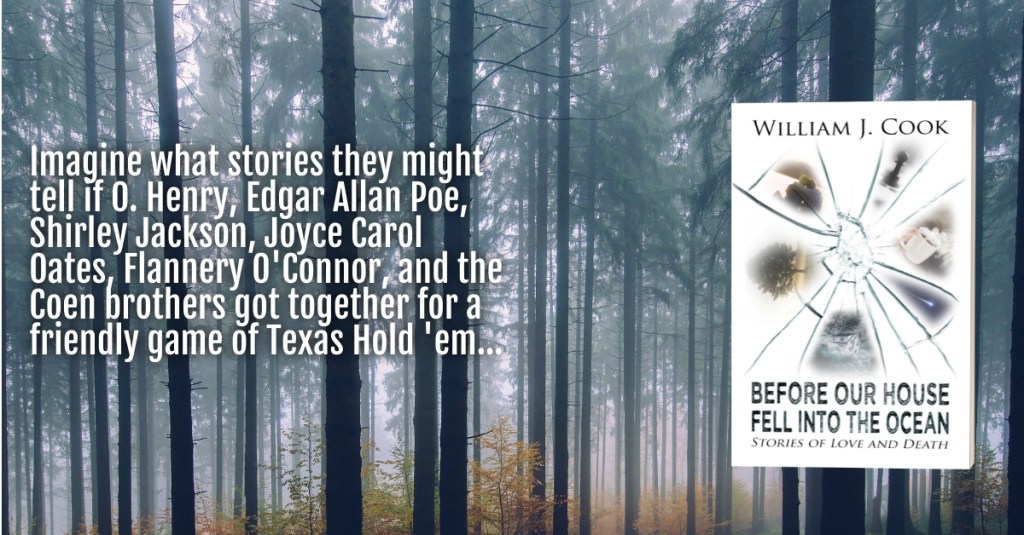
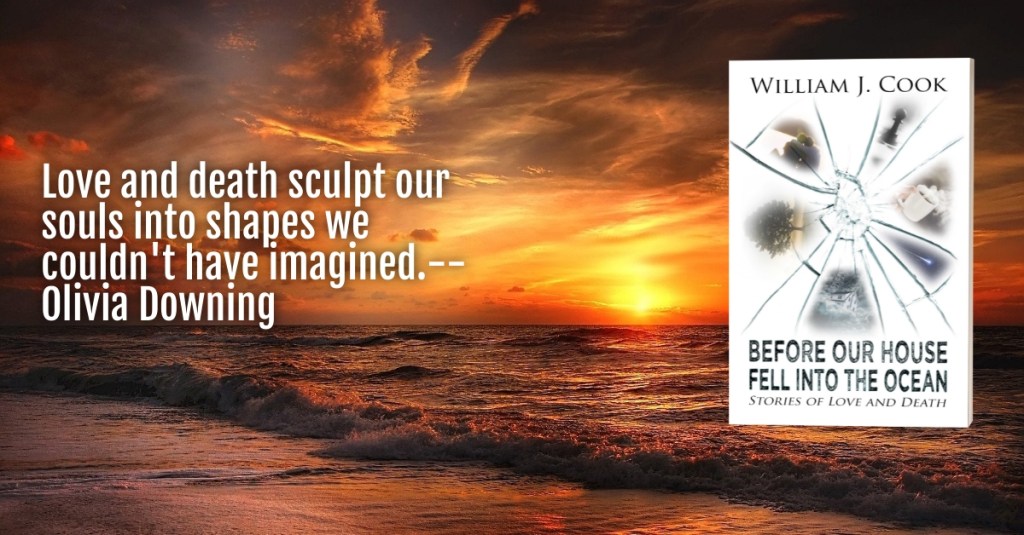
Here’s the new book cover, designed and created by Roslyn McFarland. Each image in the broken panes of glass is an icon from one of the stories. The pawn is from The Chess Player; the steaming mug from Coffee; the shooting star from Starfall; the falling house from Widowmaker; the oak tree from The Arborist; and the young lovers from Gargoyle. I’m still aiming for a late September or early October release. If you haven’t done so already, please subscribe to my newsletter to stay current with the latest updates and to learn about other indie authors whose books should be in your queue! Subscribe here.

An Interview With Indie Author Shawna Reppert

Shawna Reppert, an award-winning author of fantasy and steampunk, is proud of keeping readers up all night and making them miss work deadlines. In addition to the Ravensblood series and the Werewolves and Gaslight series, she has written several stand-alone novels.

Bill: Shawna, please tell us how and why you became a writer and how your creative process works.

Shawna: I became a writer because I couldn’t imagine not being a writer. As soon as I realized that someone wrote the stories in my Little Golden picture books, I knew that that’s what I wanted to do. One of my earliest memories before I could even block-print my name was insisting that my mother write down a story I was telling her.

As far as process, I started out as a pantser, as I think a lot of us do. I had some idea of story arcs and character arcs and how to put a story together. I knew the character I wanted to write about and generally how the book or story would end, and off I went. But repeatedly writing yourself into corners isn’t fun.

Then I took a seminar with the amazing teacher, Eric M Witchy. Eric insisted he didn’t make me write an outline. (He kinda did.) But in the process of writing the outline, I realized that if I had pantsed that novel, I would’ve ended up in a world of hurt when I reached the last chapter. I would’ve had to do a substantial rewrite of the entire book to weave in a character that made the resolution possible. I took to outlining with the fervor of a convert.

I tend to use the hero’s journey as outlined in Vogler’s book The Writer’s Journey as the outline to my outline, if you will. I feel the universal archetypes and story patterns slip past the conscious mind to speak to the soul of the reader.

For a while, I had a complex system of index cards, color-coded for POV and labeled with the part of the journey that each scene represented. I’m now 10 novels in and I’ve internalized the structure of story and character enough that I no longer need quite such a formal process. But if I find myself bogging down in a chapter, I’ll outline the section to get a better idea of what needs to happen and in what order to make the novel work.

A lot of writers, especially beginning writers, think that outlines are dull and that outlining takes the joy of discovery out of the creative process. For me, it’s just the opposite. It’s like stepping back from the painting to see the whole picture more clearly. When I outline, I can make connections between characters, events, back-story, etc. that I didn’t see before. I can then strengthen those connections for a deeper and more powerful story. Maybe because I’m a story geek, I find the whole thing very exciting.

Bill: I’m a big fan of “walking the streets and alleyways of Alternative Portland” in your Ravensblood series. Can you tell us about the books and what gave you the inspiration for them?

Shawna: Ravensblood is a dark urban fantasy with a strong redemption arc. My protagonist is a powerful dark mage seeking redemption by becoming essentially a double agent for the Guardians (The division of the police to handle magic crimes in my alternate universe). He is spying on his master William, whose ambition to rule threatens the Three Communities, perhaps even the world. To keep his cover, he has to commit acts that threaten to pull him even further down into darkness.

In later books Raven, having won his pardon, has to learn to accept his dark past, redefining himself and reintegrating into a society that isn’t always ready to accept a reformed dark mage into its midst, all while helping the Guardians with new (and old) threats.

I lived in Portland for a little over a decade and still live just under an hour away. I love the Pacific Northwest, and so wanted to use it as a background. Some of the places mentioned exist in the real world, some are purely fictional. Some are a little of both—for example, in Ravensblood, OMSI has an extra ‘M’. (It’s the Oregon Museum of Magic, Science, and Industry.) The bullet-nosed Stude that makes a cameo in the first book of the series actually was parked for years in a SE Portland neighborhood very similar to the one in which that particular ambush took place. I particularly like putting in those quirky little spots that make Portland so…Portland.

My late editor said that various McMenamins pubs show up so much that the company should give me free beer for life (I prefer hard cider, if anyone has a connection…)

I think it makes it fun for readers. I’ve been putting little notes in the front or back matter about some of the places of interest that are real-world so readers can do their own exploring.

Bill: When I started reading your Werewolves and Gaslight series, I thought “Sherlock Holmes and werewolves—cool!” But then the lightbulb went on, and I realized there was a deeper meaning there. Can you tell us about that?

Shawna: For me, it’s not enough to write a gripping whodunit without a rich, vivid backdrop to help it come to life. And while it’s lovely to read about (and to write about) splendid balls and fine dresses, and all of the beautiful things the Victorian era had to offer, it’s dishonest to do that without facing the dark underbelly of that time. There were a lot of people living in abject poverty in conditions you can barely imagine, and this is a dichotomy we are starting to see more and more in our own times, with an economy that seems designed to channel resources ever upward, so that more and more of the wealth is in the hands of fewer and fewer people.

Among other things, what drew me to writing steampunk were the parallels between the Victorian times and our own. The stereotype of Victorian times as being very frozen and set in their very strict morals and social code overlooks that it was actually a time of great flux.

Women, at least those of means, were able to accomplish a lot more than they ever had before. They were able to travel to Egypt and ride camels to pyramids. Women were even able to get higher education at Oxford. (Of course, they couldn’t actually earn a degree because, you know, let’s not go crazy.) They were starting to do things that were making the male establishment pretty uneasy. The whole image of woman as domestic goddess, unable to comprehend things like finance and politics and too delicate to be troubled by anything going on in the outside world, fit only to make the home a lovely sanctuary for their hard-working men, that was a pushback against the advances women were making towards being something other than helpmeet to men.

Social mobility was becoming a possibility. Not a probability, mind you, but the very notion that one could rise above the station one was born to was pretty revolutionary. It challenged the notion that one’s place in the world was decreed by God.

In Victorian times, people of the working class could get an education. Benevolent religious organizations were holding free schools, where even an absolutely dirt-poor beggar kid could learn to read and write. There was a lot of concern among the upper classes that working people would start “getting above themselves.” They were feeling threatened and pushed back by trying to make certain the rigid social lines that protected their privilege were kept in place.

We see the same sort of dynamic in our own times. There have been great strides toward justice and equality. We had a black President. We have a marriage equality act. These are all things I never thought I would see in my lifetime, and I am very, very glad to have been wrong. And now we are facing rapidly escalating push-back by people who are vested in preserving the former status-quo.

The London of my steampunk world faces the social inequalities of the real Victorian London, plus it has werewolves, the very bottom rung of the social ladder. Sometimes it’s easier to talk about hot-button issues by moving the discussion into another time and (slightly fantastical) place.

Bill: You’ve written several other books besides these series. Would you care to highlight some of them?

Shawna: I’ve published three stand-alone novels with a more traditional fantasy feel. The most recent of my stand-alones, Brother to the Wolf, is sort of a passion-project. I didn’t want to do another version of Robin Hood. There’s plenty of those out there already, some good, some great, some that…er, don’t add a lot of merit to the subgenre. But since I love the Robin Hood legend, and especially the older, more pagan versions of the tale, I created an alternate world with similar history and conflicts and wrote an original tale with similar themes.

Where Light Meets Shadow is a male/male fantasy romance with elves, healers, and bardic magic. I definitely wanted a plot that encompassed more than just a romance. There are two races of elves in an uneasy détente following a bloody war in which neither side was entirely right or wrong. The two lovers will either help heal the divide between their two peoples, or be torn apart in a second war. Because the main protagonist is a harper, I also got to geek out over Celtic music and ask my Irish musician friends a ton of questions.

The Stolen Luck was my debut novel, another male/male fantasy romance. I actually didn’t set out to write it as a romance. I was interested in exploring what would make a good man go against his own beliefs and values, and I wanted to make that reason compelling enough that the reader could feel like, in the same set of circumstances, they might make that same choice. The romance came up as I followed that age-old advice to writers: put your protagonist in a tough situation, and then make it harder.

Bill: Shawna, thank you so much for your time. I think I can speak for all of your fans in wishing you every success with your latest project.

Would you like to learn more about Shawna and her books? Please visit her at https://www.shawna-reppert.com/. Sign up for her newsletter and get a free gift!

Also check out the Northwest Independent Writers Association at https://www.niwawriters.com/.