At last, the pre-order of the Kindle version of All the Bodies Do is available! Just click on the image above to shop now. Kindle and paperback editions will be published on June 28th. Until then, you can pre-order the Kindle one at the reduced price of $2.99. After its release, the price will be $5.99.
This novel has certainly been a labor of love, from doing research in Las Vegas, to the extensive exploration of the ins and outs of wine-making at Willamette Valley Vineyards. (Okay, my research included substantial wine-tasting, but I had to take one for the team!)
I must give a big shout-out to Jette Rainwater, Winery Ambassador at WVV, who didn’t turn me in to the FBI (thank goodness!) and did provide substantial help with vineyard and wine-making details. Also, kudos to Roslyn McFarland for cover design and creation. And hugs and kisses to my darling daughter Julie, who insisted that I write this story in the first place.
No, All the Bodies Do is not the next great American novel, but I think it is a fine entertainment, and I hope you will, too.
No, it’s not their fault. Mr. Brain-Like-a-Sieve forgot to put that story into PDF format, so I’ll bet a lot of you couldn’t open it. I’d blame it on the eggnog, but I hadn’t had any! Anyway, here it is again in its corrected version. And Merry Chrismas!
I don’t pray as much as I should. One brief prayer I manage as soon as I awaken each morning is: “Thank you.” I know the older one gets, the more precarious good health becomes, and I want to be aware of how good I feel this morning. Right now. Amen.
More good health: It’s such a pleasure to write while listening to my wife painting in her studio. Her work in oil and cold wax requires a lot of scraping and layering and scraping again. The sounds are comforting, as are the clicks of my keyboard. They’re sounds of creation, birthing new works in paint and in print.
So with a heart full of gratitude, I want to thank my readers—my truly “extended family”—for your ongoing support and encouragement. May you all have a blessed holiday season and a healthy and happy New Year.
Project update: I have sent out 208 queries to literary agencies in the U.S., the U.K., and Canada. So far, I’ve received fifty rejections and two positive responses. An agent in London to whom I sent the first three chapters has requested the whole manuscript, and an agent in New York City to whom I sent the first ten pages has requested the next five chapters. Fingers crossed!
Finally, please accept this short story as a token of my appreciation. I know some of you have already read it. I wrote “Dangerous Christmas” fifteen years ago and included it in my 2017 collection of short stories entitled, Catch of the Day. I dusted it off this morning and was pleased to find that I still liked it. I hope you do, too.
It can be difficult to approach a book as it was intended to be read and not drag with us all our “modern sensibilities.” We are probably doomed to experience everything through the lens of our current beliefs, like it or not. This results in criticizing what went before as if the author or the artist or the sculptor “should have known better.” Statues get torn down, books get banned, art gets condemned. “So it goes,” as Kurt Vonnegut famously said.
I just finished rereading The Stranger, by Albert Camus, a book I haven’t looked at in more than fifty years. True confession: I was struck by the cringe-worthy scenes of domestic violence and animal abuse in the first half of the book, scenes I had never recalled from my reading the book in my youth. What I did remember was the poetic intensity of the concluding chapters of the novella, when the protagonist Meursault is in prison awaiting execution for murder. At one point he says, “From the dark horizon of my future a sort of slow, persistent breeze had been blowing toward me, all my life long, from the years that were to come.”
Against his wishes, Meursault is visited in his cell by a priest, but finds “…none of his certainties was worth one strand of a woman’s hair.” He is so provoked by the chaplain, that Meursault grasps him about the neck and shouts his rage at him. When the priest finally leaves, Meursault says, “It was as if that great rush of anger had washed me clean, emptied me of hope, and, gazing up at the dark sky with its signs and stars, for the first time, the first, I laid my heart open to the benign indifference of the universe.”
But it was the final sentence of the book that had so disrupted my quiet seminary education all those years ago. Interestingly, I’ve learned that newer translations have changed the wording to bring it more in line with the original French. The version I had read was the old one by Stuart Gilbert, who apparently took some poetic license in his rendering of cris de haine. That phrase is literally “cries of hate.” Unfortunately, we so overuse the word “hate” in English (“I hate that movie. I hate that hair style.”) that we’ve eviscerated the power it has in French, so I still like Gilbert’s translation: “For all to be accomplished, for me to feel less lonely, all that remained to hope was that on the day of my execution there should be a huge crowd of spectators and that they should greet me with howls of execration.” That still gives me chills!
Currently, I’m slogging my way through The Myth of Sisyphus. It’s pretty dense, and my philosophic chops aren’t as honed as they used to be, so it can be hard going! The Plague made great reading during the pandemic. Its lucid humanity can be a bracing tonic for these divided times. I think I’ve repeated my favorite line from that novel many times before: “…a loveless world is a dead world, and always there comes an hour when one is weary of prisons, of one’s work, and of devotion to duty, and all one craves for is a loved face, the warmth and wonder of a loving heart.”
If you’re new to Camus, you might want to try starting with The Plague or with a shorter work like The Fall. He was also a marvelous essayist, and I’ve always been fond of “Nuptials at Tipasa.” After JFK’s death, brother Bobby Kennedy immersed himself in Camus, so you’ll be in good company.
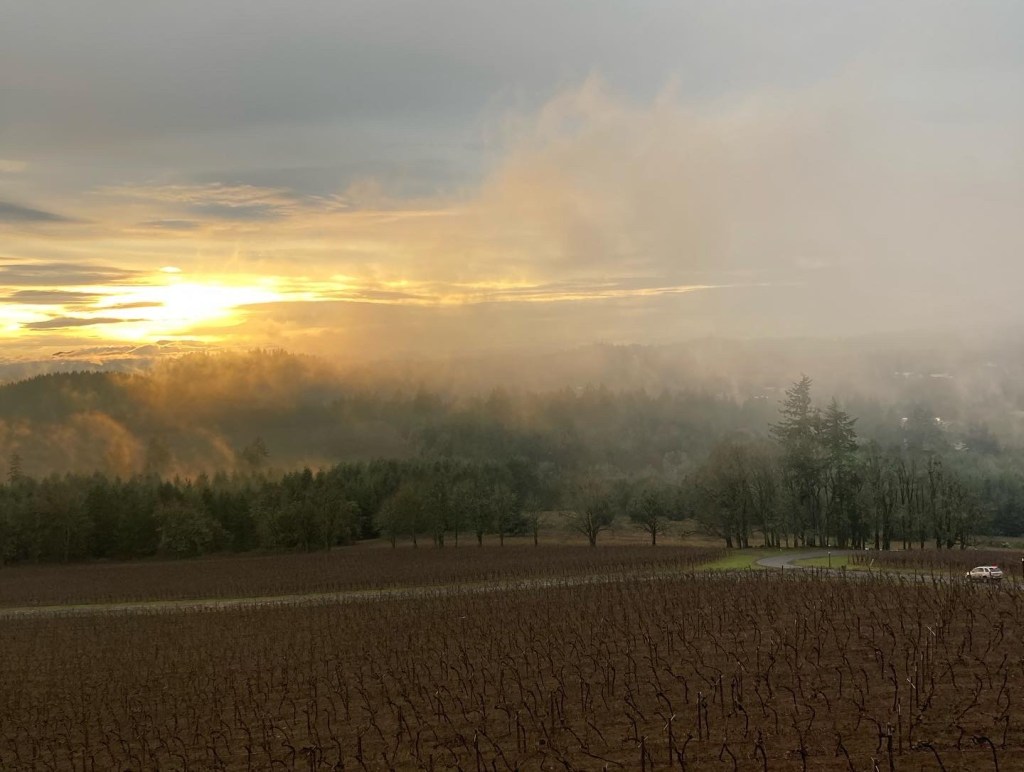
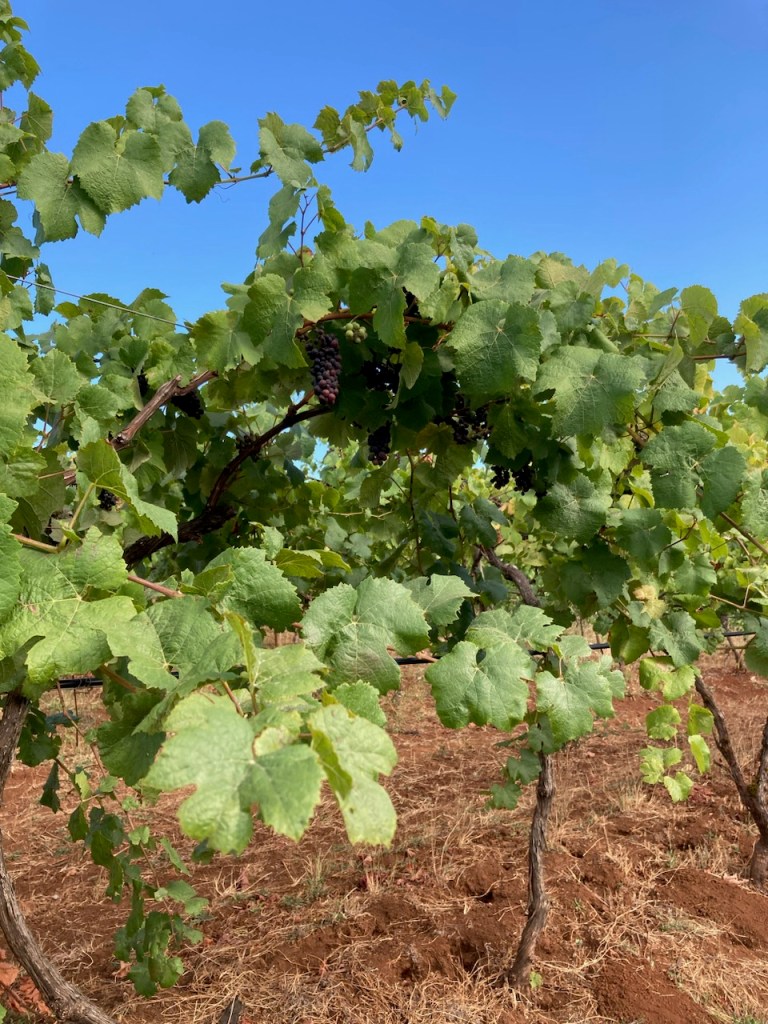
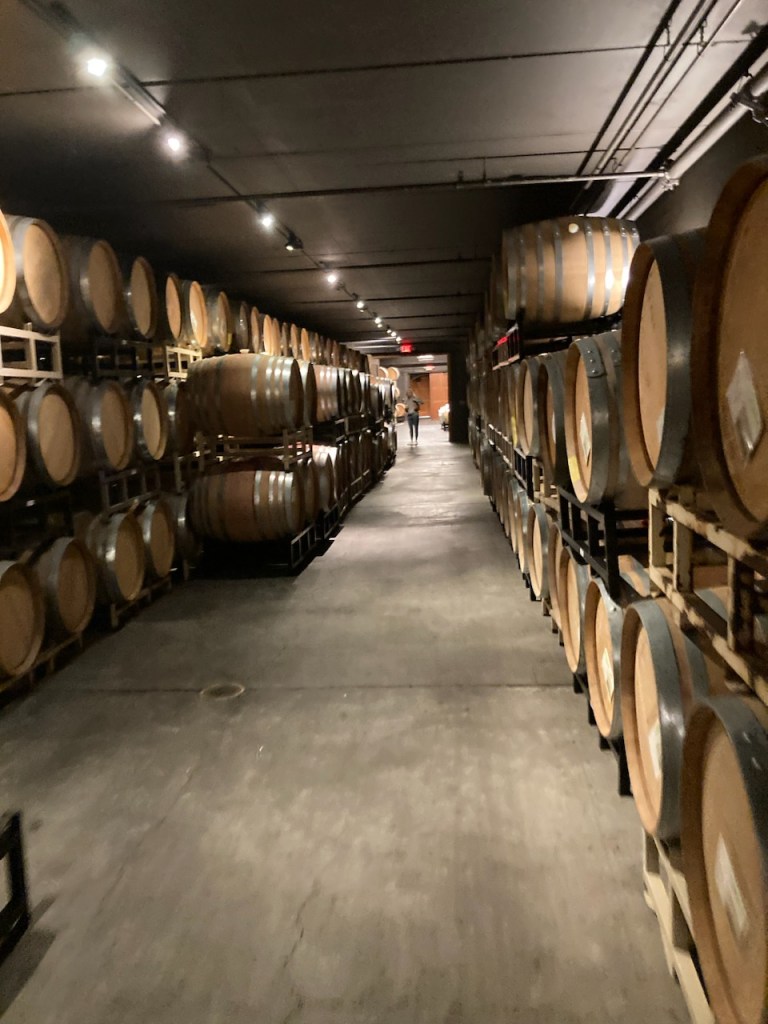
Above, I’ve pasted a picture from Willamette Valley Vineyards, about three miles from my home. It’s still winter among the vines, and they aren’t yet ready to awaken from their sleep. While they doze, the vineyard crew is busy with last fall’s harvest. Juice is fermenting, turning sugars to alcohol. French oak barrels will be home to the elixir for nine to twelve months before it is bottled, and it will rest in the bottles before it is ready to tempt the palate. As Galileo famously said, “Wine is sunlight, held together by water.”
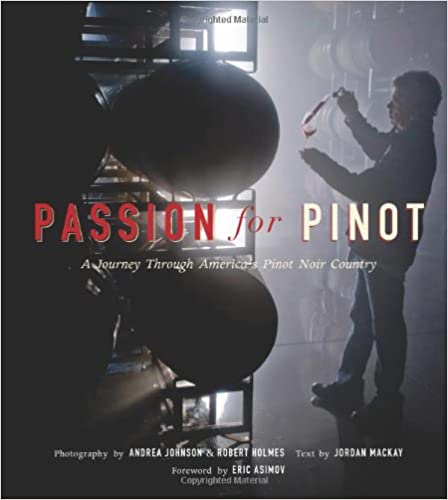
Eric Asimov, Chief Wine Critic of The New York Times, says in his Foreword to the book, Passion for Pinot: A Journey Through America’s Wine Country, “If any grape would be at home in the pose of the femme fatale—smoke curling from its lips, long, irresistible legs crossed as another winemaker is sent to his doom—it would be Pinot Noir.”
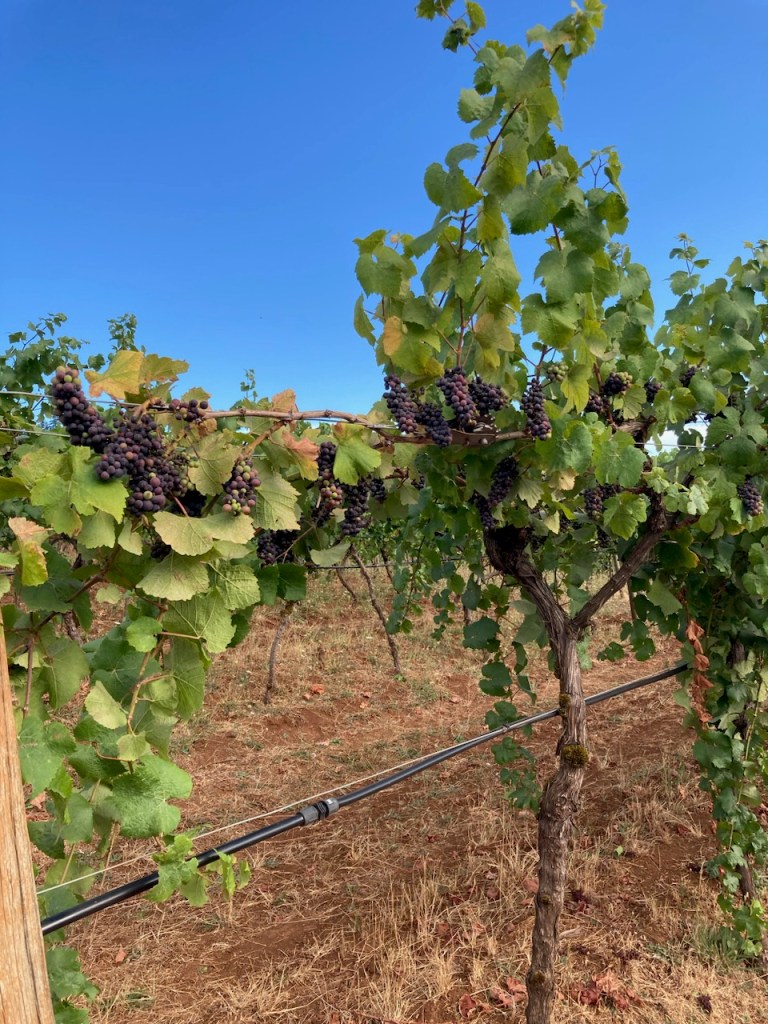
Why? Because the grape can be such a difficult temptress. Widely regarded as the “Queen of Grapes,” Pinot Noir is a challenging monarch. Thin-skinned, susceptible to any number of fungi, subject to mutation, dependent on slight variations in soil, she is as frustrating as she is rewarding. When all the variables come together under the supervision of a master vintner or winemaker, the resulting wine is a cause for jubilation, a miracle fulfilling Galileo’s maxim.
I don’t claim to be an expert on Pinot, but Passion for Pinot is a wonderful place to start a lifelong devotion to the Queen! The text by Jordan Mackay illuminates the history of the grape from root stock and vine, through harvesting and fermentation, all the way to its metamorphosis into the garnet-colored jewel we love so well. The photography by Andrea Johnson and Robert Holmes captures vineyards and wineries in every season of the year. Turning the pages, the reader can almost taste the wine—blackberry and cherry flavors, notes of cinnamon and cloves, perhaps some floral and mineral subtleties.
If you’re enthralled by the Queen, or merely a fan, add this book to your collection. (And in 2024, look for my next novel, All the Bodies Do: A Willamette Valley Mystery.)
A character in one of my stories says, “Love and death sculpt our souls into shapes we couldn’t have imagined.” (Olivia, “Rain,” in Before Our House Fell into the Ocean: Stories of Love and Death.) It was true when I wrote it, and it seems especially true as holiday season rolls around again. We grieve our losses and celebrate our loves. We all know that grief never disappears. We never “get over” the death of a loved one. Grief morphs into an irreducible part of our personality. I weep for my parents. I weep for my son. But I am ever so grateful for the love of my family and friends. I’ve probably said it before, but I’m sure when the Grim Reaper comes calling, nobody thinks about how they or their friends voted, who sits in the White House or the Kremlin, what outlandish salary an NFL player is getting. We remember the love we gave and the love we received.
In that spirit, I’m remembering my mother Janice, and I’d like to share with you a cookie recipe she invented herself. Although these were holiday cookies and usually made their appearance on Thanksgiving, Christmas, and Easter, she could be persuaded to make them any time. They are a chocolate spice cookie she dubbed “Arabian Bites.” They’re for the Cookie Monster in you!
Ingredients:
¼ cup cold coffee
½ cup raisins
1 tbsp. shortening
½ tsp. baking soda
2 squares Baker’s Unsweetened Chocolate
1 and 1/8 cups flour
½ teaspoon salt
1 tsp. cinnamon
1 tsp. allspice
1 tsp. cloves
1 cup sugar
1 tsp. vanilla
½ cup chopped walnuts
The Process:
Add coffee, raisins, and shortening to a saucepan and heat until the raisins plump. Remove from heat, add baking soda, and allow to cool. In another pan, melt the chocolate. In a large bowl, mix flour, salt, cinnamon, allspice, cloves, and sugar. Add the coffee/raisin mixture, the melted chocolate, the vanilla, and the chopped nuts. Drop by tsp. onto a greased cookie sheet (or Silpat). Bake 8-10 minutes at 375. Remove from cookie sheet and roll in confectioner’s sugar. (Over the years, we have substituted chopped dates for the raisins, and sometimes pecans for walnuts. It’s all good!)
Love you, Mom!
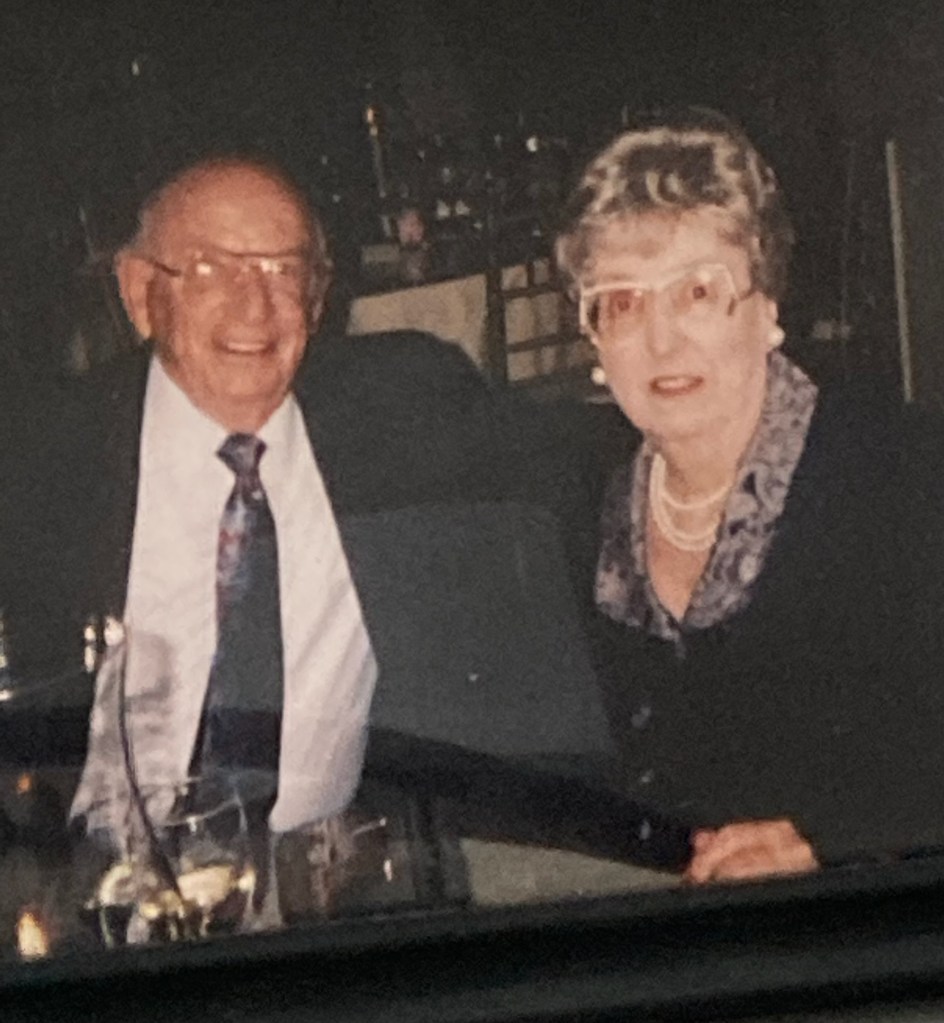
Here’s a picture of Mom and Dad
And here’s a picture of the front side of Mom’s recipe card. The coffee stains made it increasingly harder to read the recipe, and unfortunately we wrote over her lovely script many years ago, before we realized what a treasure it would be had we left it alone!
I live with an artist wife, and Sharon never ceases to amaze me. She enters her studio (formerly, our dining room!) in “paint clothes” (of course, she’d be beautiful even dressed in rags!), starts blending different colors, and confidently approaches her easel armed only with a palette knife. Hours later, she emerges, the cutest smudges of paint on her nose and cheeks, and asks me to take a look at the initial phases of the piece she is birthing. (It seems appropriate that what she is painting on is called a “cradled birch panel.”) Her work staggers me. Here’s her website.
The Oxford Dictionary defines abstract expressionism as a development of abstract art that originated in New York in the 1940s and 1950s and aimed at subjective emotional expression with particular emphasis on the creative spontaneous act. Wikipedia says it put New York City on the map, eclipsing Paris as the new hub of art in the West. I don’t know about all that, I only know my wife’s work knocks my socks off. Here she is:
So why have I’ve called my blog “Art and Crime?” I don’t mean to imply that Sharon is in any way a criminal—far from it! But I write murder mysteries. As I’ve accompanied her to showings at the galleries that feature her work, I’ve learned that art galleries are far and away one of the best places to launder money! Oh, I thought, I can use that! And indeed I have.
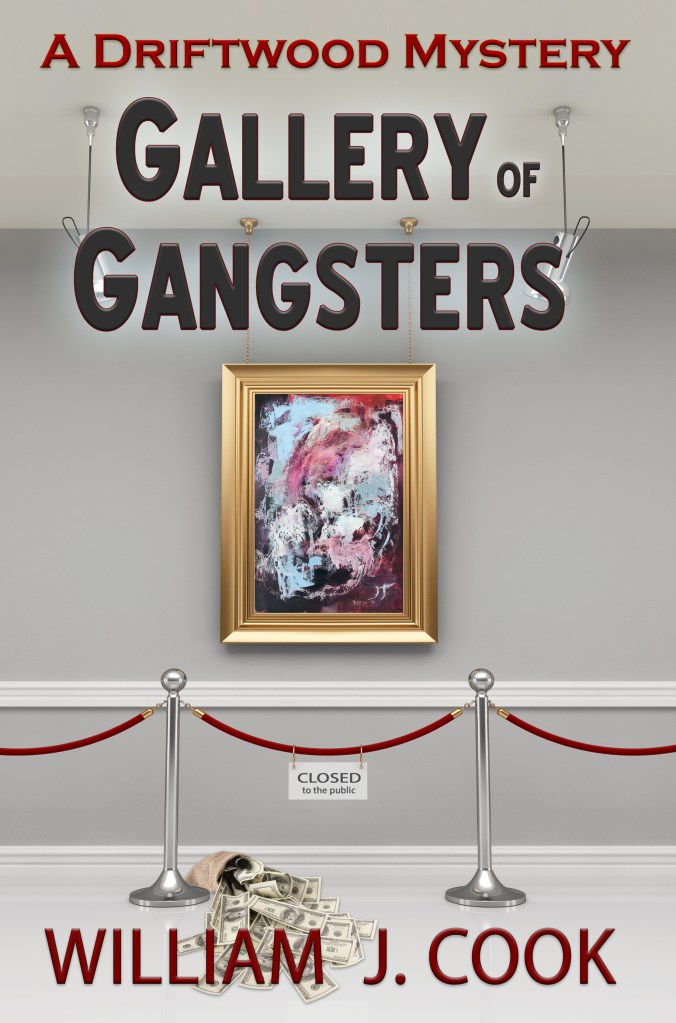
Gallery of Gangsters is the final book in the Driftwood series (and one of Sharon’s paintings is on the cover!) If you click on the image below, you can read the first chapter. Let me know what you think.
The book will be released on August 24. Pre-order it now for only $0.99—a $5.00 savings. Here’s the link.
I’m going out on a limb here, testing the waters to see if issues like this can be talked about rationally without starting a fight. I wish to offend no one, just to start a different sort of conversation about this—a clinical discussion.
I’m talking about the so-called “Don’t Say Gay” law in Florida. Do I think promulgating this law was politically motivated? Absolutely, shamefully so. But—and this is a big but—there is some truth to the law. Please let me explain.
I worked for 37 years as a clinical social worker. During that time, I worked with thousands of children and their families. In my training, we were taught that all human beings go through psychological “stages” as they mature. Those stages have different names depending on which authority you consult, but they all look at the developmental tasks children must complete in their growth. Children from Kindergarten through grade 3 are focusing on relationships—learning to share, building empathy—and also learning foundational skills in reading, writing, mathematics, etc.
One school of thought refers to this period as “latency,” a time when sexuality takes a back seat to these other skills. Of course, children are “sexual beings” from the beginning of their lives, but sex isn’t the focus at this time. Certainly, they may occasionally “play doctor” or ask “where babies come from,” but good parents give brief, child-friendly answers and direct them back to other activities.
Sexual abuse at this time of life is particularly harmful because it pushes the child out of “latency” and “sexualizes” them—sex becomes the focus of their thoughts and behaviors. They may abuse other children as they were abused. Interpersonal relationships suffer. Academic skills falter.
Please understand: I’m not claiming that teaching these very young children in school about LGBTQ matters is abusive, only that it’s too early for them to process it, and it poses a risk of making sex a focus of their lives when there are other issues that need their attention.
I don’t mean to offend my gay, lesbian, transgender brothers and sisters. And I wholeheartedly celebrate diversity in our society and equality under the law. I just have doubts that teaching Kindergartners in school about these things is the way to go. I would love to hear back from some child psychologists and psychiatrists to fact-check whether I’m making any sense or not.
Had not my daughter insisted, I would have gone to my grave never having eaten a raw oyster, and I would have been much the poorer for that. During a trip to San Diego last year, she introduced me to them. On our trip last week, I knew she had changed my life.
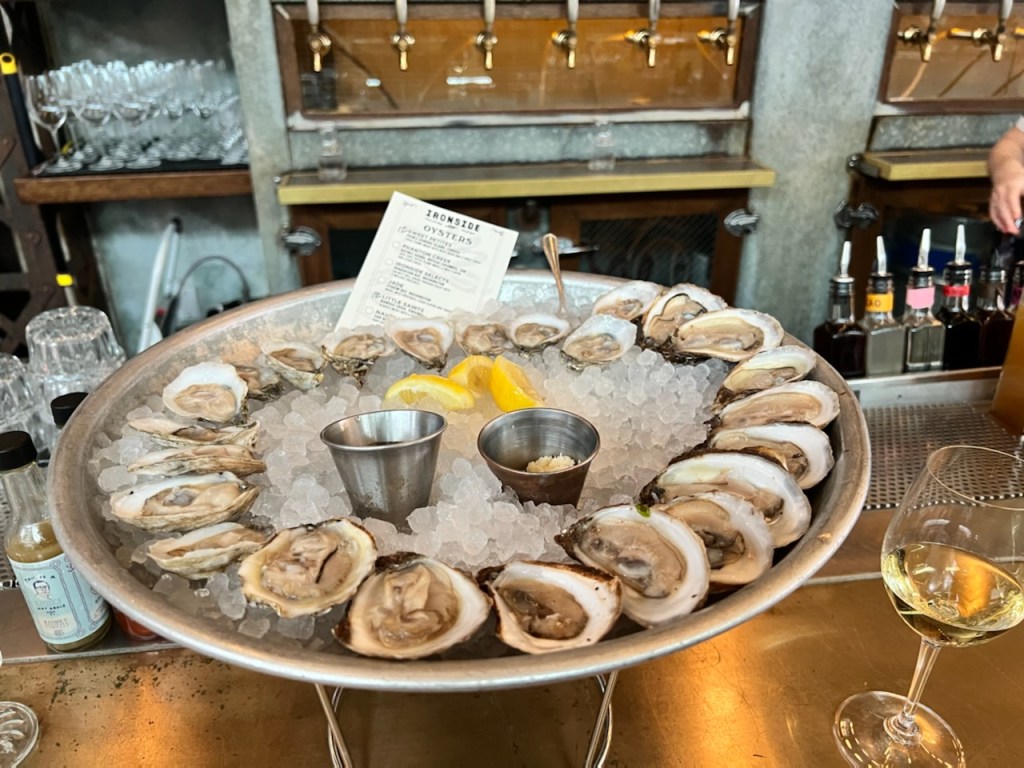
I’m sure ambience is important, and there are volumes to be written about the atmosphere in Little Italy, a suburb rich in culture and glorious food. Our go-to destination has never disappointed us. Although no visit is complete without a classic Italian dinner at Buon Appetito on India Street, (this trip, it was the superlative Osso Buco on a bed of risotto), our seafood target is Ironside Fish and Oyster across the street. In fact, it was so good, we had dinner there one evening and went back when it opened for lunch the next day!
The restaurant itself is rather playful, with a giant octopus hanging over the diners and ship figureheads high in the corners. The entry on Yelp says that Michelin star chef Jason McLeod is in charge.
There were four of us eating, and my daughter ordered 24 oysters. There were half a dozen varieties of oysters to choose from, and she chose the two smallest kinds, which she considers to be the sweetest. The oysters were arranged in a circle on a bed of ice on a round plate with fresh lemon wedges and little metal cups of champagne vinaigrette and horseradish. My preferred method of eating them was with only a few drops of the vinaigrette.
Sipping an oyster from its shell is a wonder like no other—the fresh breath of the sea, the delicate taste of the oyster, the bright taste of the chilled Chardonnay afterward. Truly, it elevates a culinary experience to a spiritual one. The simplicity and the elegance evoke images of fine art and music. It is cuisine as poetry.
The master of letters, Ernest Hemingway, said it best in A Moveable Feast, when he wrote:
“As I ate the oysters with their strong taste of the sea and their faint metallic taste that the cold white wine washed away, leaving only the sea taste and the succulent texture, and as I drank their cold liquid from each shell and washed it down with the crisp taste of the wine, I lost the empty feeling and began to be happy and to make plans.”
This week I watched a 48 Hours episode on CBS about the 2003 fire at the Station, a nightclub in Warwick, Rhode Island. One hundred people were killed, and another two hundred were injured. When I had first heard about the tragedy eighteen years ago, I remember telling myself, “If I were still living in Rhode Island, I’d be dead now.” Let me explain.
I moved to the little community of Riverside, Rhode Island, just south of Providence, in June of 1974, fresh out of graduate school at the State University of New York at Albany. My former wife and I rented a duplex on the narrow peninsula called Bullocks Point, and a few years later we purchased a house right on the banks of Narragansett Bay, where we remained until 1989, when we moved to Oregon.
The house was old but comfortable, and we remodeled it piece by piece over the years. A side porch was converted into a bedroom for two foster adolescents. The back porch became a kind of office/playroom with a wood-burning stove. A new deck in back became the best place to look out over the bay, breakfast coffee in hand, and watch sailboats in the summer and water fowl in winter.
Directly across the bay was the little town of Cranston, and south of that was Warwick. It was pleasant to watch the city lights on the water after sunset, and especially fun to watch the traditional party bonfires on the beaches up and down the bay on the night before the fourth of July.
I confess, my tastes in music back then were quite juvenile. In fact, I was a bit of a metal head when the “hair bands” were so popular. I loved MTV and stayed up late on the weekends to watch Headbangers Ball. I saw AC/DC, Judas Priest, Whitesnake, and Great White in concert. (Another confession, I often “hired” a nineteen-year-old who lived down the street to accompany me to concerts. That way, if I got a ribbing that I was the oldest guy at the show, I could claim that I was just here treating my teenage neighbor in thanks for some good deed he had done for me.)
Bottom line, if I had been in Riverside in 2003, I would have gone to see Great White at the Station. It would have been a walk down memory lane, a tip-of-the-hat to a bygone decade, a little sip at the fountain of youth. I would have been right in the thick of it, hemmed in on every side, unable to escape when the terror erupted.
The phrase terminal velocity popped into my mind as I was thinking about all of this. That’s the fastest speed an object can attain if it’s falling to earth, because air resistance prevents it from accelerating further. A skydiver free falling from a great height reaches terminal velocity, about 120 miles per hour, in about twelve seconds.
But aren’t we all “falling to earth?” Perhaps terminal velocity can be applied to the arc of our lives. I wonder if the individuals caught in that holocaust in Warwick had lived long enough to reach their own personal terminal velocity. It feels like I was granted a reprieve, a stay of execution, by moving out west when I did. I was given the time—the grace—to reach my own terminal velocity. Have I used it wisely? As I remember the conclusion of Spielberg’s Saving Private Ryan, the older Ryan’s words haunt me.









 William J. Cook