Author: authorwilliamcook

Unknown's avatar

About authorwilliamcook

I grew up on the east coast, where I attended two Catholic seminaries before getting my Master's Degree in Social Work at the State University of New York at Albany. I moved to Oregon in 1989, continuing my career as a mental health therapist. I am now retired and I divide my time between babysitting for my 15 grandchildren and writing.

Book Review: Raven’s Heart by Shawna Reppert

It is such a delight to be back in alternative Portland with the third book of the Ravensblood series. I find it compelling to get drawn into an urban fantasy set along streets I’ve walked down and places I’ve been. It’s that added layer of realism that lends such believability to a story of incantations, artifacts and magic.

The players are back: Raven, still working on his redemption by consulting for the Guardians, the police force combatting magical crime; his lover Cassandra, still cautious in light of his previous betrayal; the dark mage William, now wielding only a shadow of his former strength after the cataclysmic battle in the last book. But William has scoured the ancient archives and libraries and has discovered the whereabouts of long-forgotten artifacts of death magic which will restore his power and lay the city and the world at his feet.

As always in this series, the characterization is rich and textured, the emotional tone, complex and engaging, the action sequences, stunning and cinematic. I especially liked the ending, which is as wholly satisfying as the narrative that builds up to it. Ms. Reppert weaves her story like casting a spell, capturing the reader in her own brand of magic. And I will never be able to look at Vista House in the Columbia Gorge the same way again. For me, it will remain forever the setting for the climax of a novel which will haunt me for a long time to come. Here’s a link: Raven’s Heart

Another Shameless Self-Promotion

Writing books is fun; promoting them is not. I continue to experiment with marketing strategies. This week, on April 20 and 21, Seal of Secrets will be free and each of the three other books in the Driftwood Mysteries series will be only $0.99. I guess it’s a little like fishing: I cast my line out, using the freebie for bait, and hope to get a bite on the discounted books. My goals are modest, namely, to get more reviews and to earn enough to pay for the promotions. (Of course, the immodest goal is for just that right person to pick up one of my books. You know, the guy with the connections at Netflix and/or Amazon Prime, who says, “Hey, I can make a screenplay out of this!”) Anyway, that’s my version of buying a lottery ticket— the chances of hitting it are considerably less than being struck by lightning on the way to pick up my mail, but so what.

That being said, although the freebie will end after those two days, I’ll continue to discount the others through May 4. I’ve got my fingers crossed for Dungeness and Dragons, which has gotten such good professional reviews and that nifty little gold medallion from indieB.R.A.G.

Meanwhile, work on the short stories is continuing. One has actually morphed into a novelette, about four times longer than the others.

Well, dear friends, that’s my story and I’m sticking to it!

Mybook.to/Driftwood

An Update and Some Teasers

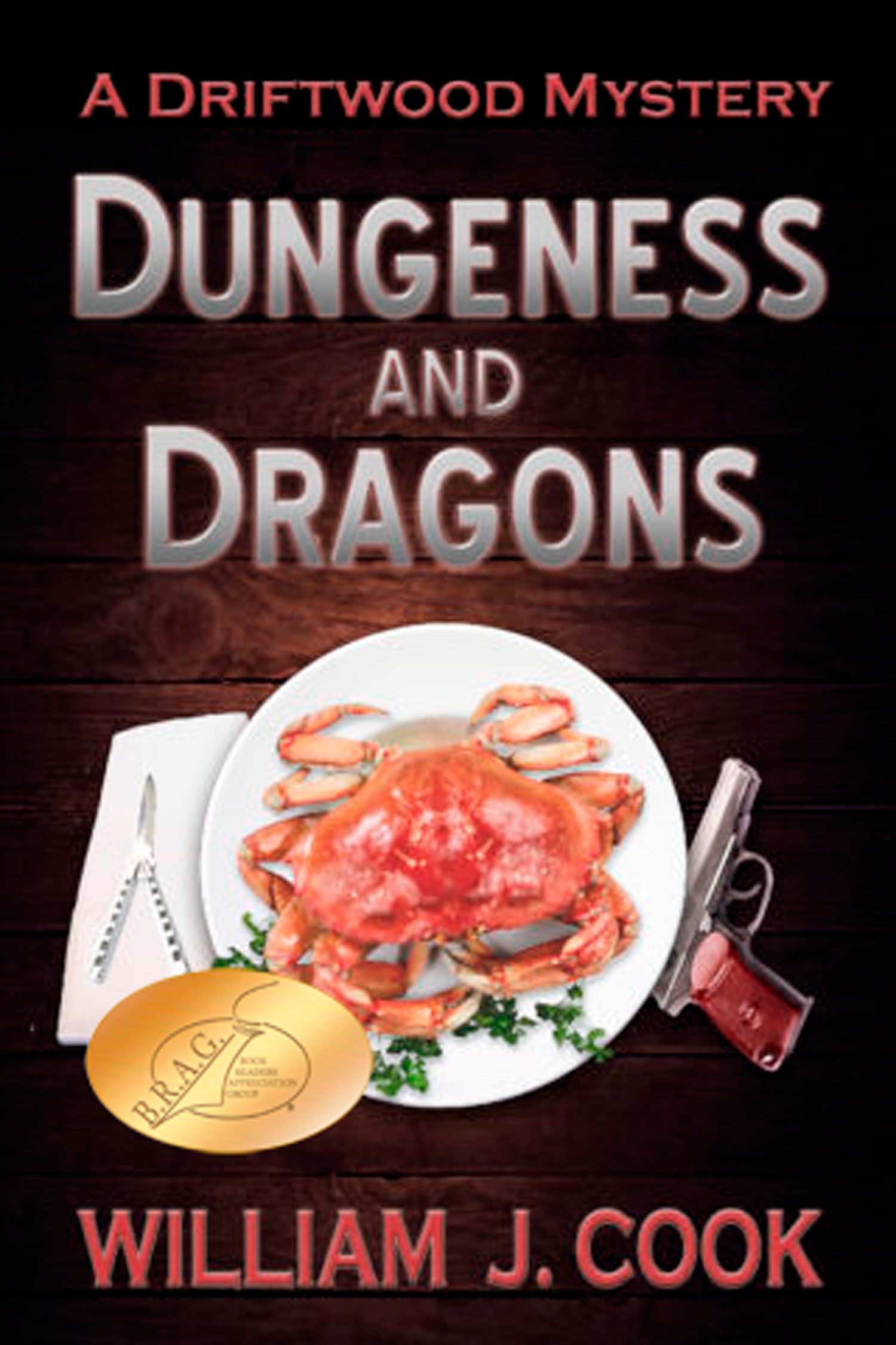
I am happy to report that Dungeness and Dragons has just been awarded an indieBRAG Medallion, a special recognition by the indie Book Readers Appreciation Group. Here’s the cover with the medallion on it:

I’m hoping that every little bit helps with marketing!

Meanwhile, I continue to work on my next volume of short stories. Here are a few beginnings:

Gargoyle

Whoever said, “Sticks and stones may break my bones, but names can never hurt me,” couldn’t tell his ass from a hole in the ground. At 13-years-of-age, Gary already knew this. A veteran of six different schools across Oregon, Washington, and Idaho, he knew names could be exquisite torture. The heir of a severe cleft lip and palate, and victim of a botched surgery, he had a face that bullies said could stop a clock. Gary Gargoyle they called him behind his back, always just loud enough for him to overhear.

A Better Mousetrap

You know you’re old when having a successful bowel movement after your first cup of coffee is reason to clap your hands and call up a 60s rock playlist on your sound system. So, I sat there, hands wrapped around my second mug, a stupid grin on my face, listening to Grace Slick’s defiant “Somebody to Love.”

Coffee

No, zombies don’t eat brains, but we’re particularly fond of coffee. Doctors say that something in the coffee slows down the demyelination of the nerve bundles responsible for the symptoms. I don’t understand anything about that. I only know that I crave the stuff.

Rain

“God’s tears,” Jeremy thought, as he sat at his desk watching the gray rain sweep across the empty lot behind the old white house and finally tap against the window in front of him. He looked at the Roman collar he had plucked from his black shirt and laid on the desk next to the letter he had just penned. What he was about to do could not be undone once set it in motion.

Widowmaker               

Before our house fell into the ocean, I used to enjoy watching my mother dance in the kitchen with her sisters every Friday evening. Because her sisters didn’t want her to backslide and get sick again, Aunts May and June would come over after work, each bringing a bottle of wine, “to start the weekend right.”

The Arborist

“Tree is telling stories again,” he said, his open palm resting on the gnarled bark of the enormous white oak in our front yard. He spoke in his characteristic monotone, his short blonde hair framing his ever-serious face. Upset that the tree would have to come down, my 11-year-old son Dax was spending most of his free time sitting under its branches, “listening” to what it had to say. It made me regret once again that I had made the comment aloud a month ago when we learned of the tree’s sickness. “Boy, if this old tree could talk, imagine the stories it would tell.”

I hope the Muse keeps moving! Target time for publishing is mid- to late summer. I’ll give you plenty of advance notice.

Hello, Again!

What can I say? I just don’t post much. I’ve all but weaned myself off Facebook–it began to feel like a black hole to me, sucking up time that I felt could be better spent elsewhere.

On a positive note, Diane Donovan, Senior Reviewer for Midwest Book Review, has just published her review of Dungeness and Dragons on her website, and it’s in the February edition of MBR. Here’s the link to it on her site: D&D Review

I’m feeling blessed right now–our electric power came back on yesterday at 4:00 P.M. after being out for six days due to an ice storm. Fortunately, our gas fireplace kept us warm, and no trees fell on our house. Of course, prayers go out to all those people in Texas who have it far worse than we did.

Although I haven’t been able to write this week, I hope to get back to it next week. I have drafts of several new stories for the upcoming volume, which is tentatively entitled, Before Our House Fell Into the Ocean. At this rate, publication probably won’t be until sometime this summer. In a future post, I’ll include some excerpts from the work in progress.

Stay well, dear friends.

The Last Update of 2020

Turning and turning in the widening gyre   

The falcon cannot hear the falconer;

Things fall apart; the centre cannot hold;

Mere anarchy is loosed upon the world,

The blood-dimmed tide is loosed, and everywhere   

The ceremony of innocence is drowned;

The best lack all conviction, while the worst   

Are full of passionate intensity.

                                           —The Second Coming, by William Butler Yeats

I don’t know if there is a more perfect poem for 2020. If you haven’t read it in a while, I recommend a re-read. It’s easily available on the Internet and it’s truly riveting.

My intent here is simply to bring families and friends up-to-date on what’s happening in my little corner of the world. Although many good things have happened in my life, I’m almost embarrassed to mention them in the light of all the losses others have suffered. The fires that ravaged the Santiam Canyon left families without homes and sometimes without loved ones. The pandemic has touched the lives of everyone, taking a terrible toll in grief and loss of life. And, of course, politics have been so destructive of anyone’s peace of mind.

That said, my family has been blessed and I am very thankful. My writing has taken a different turn. I spent a lot of time this year doing free promotions, which resulted in more sales than I’ve ever had before, as well as many more reviews and ratings on Amazon. In addition, for the first time I solicited “professional reviews”—those done by experts in the field who work for a fee and never guarantee that the review will be positive. I’ve submitted my latest novel, Dungeness and Dragons, which I published in April, to Kirkus Reviews and US Review of Books. I’ve used one-sentence excerpts from them for “Editorial Reviews” on the book’s Amazon page. Click on those names if you’d like to read the full reviews.

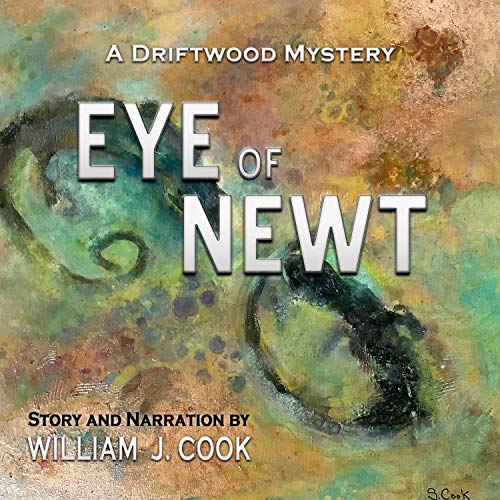
The other news is that my narration of my short story, Eye of Newt, finally got released as an audiobook this week. It’s a hoot to go to the book’s page on Amazon, click the “Sample,” and listen to my own voice! The book is a little less than an hour long, and I have to admit, it was a pretty torturous process doing it. I have way more respect for audiobook producers now!  Will I try to tackle a full-length novel, which would probably be ten times the work I put into this little project? Maybe it’s a tiny bit like the woman who has just given birth saying “Never again!” and then she forgets the pain and has another child. We’ll see. If you’d like to check out that sample I mentioned, clicking on the title will take you there.

Finally, I’ve begun work on another volume of short stories, which I hope to publish in the spring—a little “cleansing of the palate” before I dive into the next Driftwood Mystery. Whitehorse has to do something about Volkov!

So that’s the news for now. I sincerely wish you all the blessings of this holiday season, and health for the New Year.

Progress Report and Movie Review: Tenet

My apologies to friends and family. I haven’t posted anything on my website in many weeks. Lots of excuses, of course!

Anyway, here’s what I’m about. I haven’t done much writing recently. I have a new short story, “The Sword,” which will be published in November in the Northwest Independent Writers Association’s anthology, Escape. I’ve started another but I’m bogged down at the moment.

Most of my energy has been channeled into learning how to do my own audiobooks, and it’s a very steep learning curve! I’ve taken an online course (many times!) and I’m in the process of doing my short story, “Eye of Newt.” I’m sure you know that’s the second of the Driftwood Mysteries, epilogue to Seal of Secrets and prologue to Woman in the Waves. I decided to start small to learn the ropes before launching into a full novel. That was a good decision. Although the book is only an hour long, the editing takes many times that. I’m sure as narrators get more experience, the editing comes more easily, but I spent three hours doing five minutes of the book! Yikes! And after all that, it didn’t pass muster. (There’s a plug-in for the Audacity software called “ACX check” that analyzes the material and determines if it meets ACX criteria (ACX is the Amazon company that publishes audiobooks). The big culprit was “noise floor too loud”—geek-speak for too much background noise. What to do?

You must understand, my recording studio is my wife’s closet. Besides being surrounded by her noise-dampening clothes, I hung towels over her shoe rack and blankets over the door behind me. But I hadn’t taken into account the ceiling. Since necessity is the mother of a lot of nonsense, I suspended a mattress pad over my head. (Good thing I’m not claustrophobic!) That, along with an update to my editing instructions, solved the problem. My next version passed the test. But was it of the quality that devotees of audiobooks expect in their purchases? I sent an excerpt to two people who listen to a lot of audiobooks, and both said the quality was good, but that most narrators try to make subtle distinctions between the speaking voices of different characters. Oh, well, I thought. Not gonna  happen now. Until I realized I had made a critical mistake in the very first sentence!

OK. In for a penny, in for a pound. It takes me fifteen minutes to set up my sound studio, whether I’m doing a retake of a single sentence or redoing the whole book. So back into the closet. I redid the story, trying to achieve some differentiation between the characters. The recording now sits in my computer, awaiting the time I build up enough nerve to tackle the editing again. Stay tuned.

Next, I took a calculated risk and went to the theater yesterday. Recalling my movie-going before the pandemic, in my little town the theaters were often empty for an early weekday matinee ,and I’d get a private showing. Yesterday, there was one other person in the theater, so I thought it was probably safer than grocery shopping at Safeway.

Is Tenet worth the hype? Is it any good? Absolutely. Is it as good as Inception? Well, Inception sets an awfully high bar. It’s probably not that good, but it’s a worthy entrant into the Christopher Nolan canon, and well worth your time. I’ll give you the pros and the cons, cons first.

The Regal Cinema where I saw the film set the bass at earthquake level—I thought my seat might come unmoored from the floor. Should we start considering a class action hearing loss lawsuit against them? Sheesh! Secondly, Nolan is becoming the king of muffled dialogue. At first I thought it was my old-man ears, but I saw comments from others on the internet. Dialogue lost in background noise, poorly articulated by actors. WTF, Christopher! You can do anything on film. Why can’t you let us understand what your characters are saying? Finally, and this is only a minor quibble, there is no character development. The main character doesn’t even have a name—he’s simply The Protagonist. But hey, we don’t go to Christopher Nolan movies for in-depth characterization. We’re there for mind-boggling concepts and plot, and eye-popping special effects. On that score, Tenet delivers in spades.

The pros—what an idea! And I won’t give away any spoilers here. It’s a wildly inventive concept splashed across riveting action sequences that will likely blow your mind, or at least trip a few circuit-breakers. And the deeper you get into it, the more convoluted it becomes (in a good way!). I think I actually understood about 85% of it on a first viewing, which is pretty good for me. I’m still kicking myself that I didn’t grasp the real significance of the title until I read about it afterwards. I should have figured that out. Speaking of which—see the movie cold, then read about it afterwards online. The pure nerdiness of the film is enough to blow anyone’s mind. (Ever hear of a Sator Square before? I hadn’t, but it’s woven into the fabric of the film.)

So Christopher Nolan has done it again—created a thinking person’s blockbuster that will leave you talking about it for days afterward. For me, entertainment that engages your mind as well as your emotions is what it’s all about. Yes, you have to work for it, and yes, you’ll have to see it more than once, but I’m onboard. Highly recommended.

My Two Cents

“Nobody told me there’d be days like these.

Strange days indeed.”

–John Lennon


At 3:00 A.M. this morning, I couldn’t shut my brain off. I got thinking about all the money and energy being spent in taking down the offensive monuments that litter our country. I had seen a news feature earlier this week about how Italy has come to terms with its checkered past. It hasn’t demolished the Coliseum, where thousands of innocents were slaughtered, or the monuments to the Roman emperors who bathed the country in blood. It hasn’t bulldozed the plazas and buildings and statues that celebrate Il Duce, the fascist dictator Benito Mussolini. Instead, Italians try to understand their history. I found myself wondering, “What if we had hired the most renown writers in the world—Nobel Laureates and Pulitzer Prize winners—and had them write plaques to adorn every monument, explaining its context and what we can learn from it?

The truth is, if we try to erase our past—to repress it—the chances are good it will emerge subconsciously and taint the body politic. We are a nation steeped in blood, from the genocide of the indigenous peoples who were here before us, to the centuries of racism ever since. I believe we must accept the darkness within us—not deny it—in order to keep it at bay. Camus tried to tell us decades ago that we are all “culpable murderers.” Each of us is capable of unspeakable crime, but by acknowledging that fact, we can keep ourselves in check. As Kirk famously pointed out in a classic episode of Star Trek, we can decide “I will not kill today.”

It is a daunting task, recognizing the urge to destroy that dwells inside us. We watch toddlers playing with blocks, and we see immediately that they love knocking blocks over even more than they love to build with them. That same inclination has been evident in protests that turn violent (and self-defeating) under the pressure of “mob rule” and anarchy. There is a part of us that likes to destroy, to break things and burn things down, and we must remain vigilant to keep it restrained. There is also that urge to obey a “strong man,” to surrender our ethical and moral decision-making to someone who appears to be forcefully in charge. Hitler persuaded German soldiers to kill six million people. Stalin killed twelve million. Those of us who believe such atrocities are no longer possible in our “enlightened age,” mistake human nature for something it is not, and do so at their peril.

Every political system, every country, every religion, every philosophy is flawed because it has been designed by flawed human beings. This doesn’t mean we must despair. Rather, we must be attentive, forever mindful, forever alert. We must stay on point, on guard, against the personal darkness that would do terrible harm to advance an arrogant self-interest. Yes, we must pass humane laws. Yes, we must pursue equality for everyone in every possible way. But our pursuit of “political correctness” will not save us from the demons within. We cannot “defund the police” because we need them to protect us from ourselves.

I am reminded of the concluding pages of Camus’ insightful book, The Rebel. He says, “We shall choose Ithaca, the faithful land, frugal and audacious thought, lucid action, and the generosity of the man who understands. In the light, the earth remains our first and our last love. Our brothers are breathing under the same sky as we; justice is a living thing. Now is born that strange joy which helps one live and die, and which we shall never again postpone to a later time. On the sorrowing earth it is the unresting thorn, the bitter brew, the harsh wind off the sea, the old and the new dawn.”


Book Review–White Fragility: Why It’s So Hard for White People to Talk About Racism, by Robin DiAngelo

In the forward to DiAngelo’s masterful treatise, Michael Eric Dyson says, “But whiteness goes one better: it is a category of identity that is most useful when its very existence is denied. That’s its twisted genius. Whiteness embodies Charles Baudelaire’s admonition that ‘the loveliest trick of the Devil is to persuade you that he does not exist.’”

Sociologist DiAngelo proceeds to deconstruct everything we think we know about racism. She explains that racism is unavoidable and inevitable in our society, that its patterns are socialized into us from the earliest age. “White people in North America live in a society that is deeply separate and unequal by race, and white people are the beneficiaries of that separation and inequality.”

She contends that the people who do the most damage in relationships with people of color are white progressives, who assert things like, “I’m color blind. My mother taught me to treat everyone equally. Some of my best friends are black.” We become exceedingly uncomfortable and take great offense at the merest suggestion that we have said or done something racist. There the conversation stops. In DiAngelo’s words, we have no “racial stamina” to continue. And we become complicit with the very system we say we oppose.

“Socialized into a deeply internalized sense of superiority that we either are unaware of or can never admit to ourselves, we become highly fragile in conversations about race. We consider a challenge to our racial worldviews as a challenge to our very identities as good, moral people.”

The author explores how race shapes the lives of white people today, often in ways that are completely unconscious. In so doing, she shines a much-needed light on the protests happening in countries world over, enabling us to begin to understand our troubled history. If you have asked yourself, as have I, “What needs to happen next? Where should I go from here?” DiAngelo gives us a place to start.

But make no mistake. White Fragility is a difficult book to read, not because of its lucid analysis of the most troubling events of our time, but because it makes us look in the mirror. The racist isn’t only the white policeman with his knee on the neck of a black man.

The racist is me.

Book Review: The Plague, by Albert Camus

I am late with this post. I wrote this review on May 2.


In the North African town of Oran, rats begin to come out of hiding and die in the streets. Shortly thereafter, residents, in ever-increasing numbers, fall ill with a mysterious fever. As these stricken townsfolk die, Dr. Bernard Rieux recognizes they have contracted the bubonic plague. The city is shut down. Guards are posted at all the gates so no one can enter or leave. Rieux devotes himself to alleviating the suffering of the sick as much as he is able, painfully aware that the city is at the mercy of a scourge for which he has no cure. He “fights against a creation which allows children to suffer and die.”

I first read this novel when I was twenty years old, more than five decades ago, and I still have that paperback copy, its pages yellow with age, passages marked that I read and re-read for years afterward. On that first reading, I remember being shaken to my core. After all, I was a student in a Catholic seminary at the time, and this book challenged all I thought I knew about life. This past month I asked myself, “Will it still resonate? Does it have something to say to our quarantined life?”

At first, I was doubtful. I had forgotten how glacially slow the novel is at the outset. But then, about midway through, the prose becomes poetic, as the characters begin to struggle with their moral dilemmas. As Rieux’s friend Tarrou observes:

“I know positively…that each of us has the plague within him; no one, no one on earth is free from it. And I know, too, that we must keep endless watch on ourselves lest in a careless moment we breathe in somebody’s face and fasten the infection on him…The good man, the man who infects hardly anyone, is he who has the fewest lapses of attention.”

I wept again at the death of the young boy Philippe, whose “long, incessant scream” is “the angry death-cry that has sounded through the ages of mankind.” I felt the slim encouragement Rieux offers us, when he comments that in time of pestilence, we learn “there is more to admire in men than to despise.” In our own time of quarantine, I wholeheartedly agreed with his pronouncement that “a loveless world is a dead world, and always there comes an hour when one is weary of prisons, of one’s work, and of devotion to duty, and all one craves for is a loved face, the warmth and wonder of a loving heart.”

I confess I read the last third of the book through tear-dimmed eyes. One passage in particular, which documents Tarrou’s death, made me think of the extraordinary efforts of our own caregivers fighting COVID-19, and the emergency room doctor, Lorna Breen, who took her own life when, as her sister said, she was “in an untenable situation.”

“This human form, his friend’s, lacerated by the spear-thrusts of the plague, consumed by searing, superhuman fires, buffeted by all the raging winds of heaven, was foundering under his eyes in the dark flood of the pestilence, and he could do nothing to avert the wreck. He could only stand, unavailing, on the shore, empty-handed and sick at heart, unarmed and helpless yet again under the onset of calamity.”

Ultimately, The Plague is a meditation on the meaning of life and death. It examines the behavior of human beings in the face of ineluctable destiny. Some act heroically; others are driven mad.

No, this is not light reading, but you will be rewarded handsomely for your efforts.

Blog 6: “My Approach to Writing–Writing as an Addiction,” by Thomas Gondolfi


My Approach to Writing – Writing as an Addiction

by Thomas Gondolfi


Hello. My name is Thomas Gondolfi, and I’m addicted to writing. I’ve been an addict since 1979.

I’m sorry to say that this post has limited use to any aspiring writers out there. The reason is that for me, writing isn’t a lifestyle. It isn’t a fancy. It isn’t even an avocation. To me, writing has become a compulsion. I will tell my tale of weal and woe as a cautionary one.

My NEED for writing started all the way back in high school because of a competitive nature with a friend, Richard Harris, and a creative writing course by Mrs. VanCampen. I love and curse you both to eternity.

A pair of long short stories as school projects became gateway writings to a >300 page, handwritten novel, Dungeons and Dragons adventures, fan fiction, and even my own newsletter for my gaming group. An accidental sale of a piece of fan fiction intensified my habit. The rest is almost classic. I decided that I needed to write and get a novel published. I worked on two at once, sharing bits at a time with other addicts who needed to share their dependencies. Eventually, I self-published my own works and those of two other authors.

I’ll note that there is a common tenant that successful authors should write every day at a regular time. I never fully understood this statement. I kept asking myself, “Why would an author need to train himself or herself to a regime?” Because of the monkey on my back, I can’t NOT write. Let me explain so that you will understand.

Ever had that desire for chocolate <or insert your favorite sweet> even though you know you probably shouldn’t? The craving won’t go away. How about a mosquito bite that you want to scratch, but knowing it will just make it worse? You try to do something else to put it out of your mind, but it continues to nag at you. Nag. Nag. Nag. You dance around it, trying to immerse yourself into something else. In the end, you usually succumb, quieting that longing at least for a moment for having indulged.

Now imagine, if you might, that the itch you have is within your head. You have an image of an unusual story, a snarky character, or a grandiose setting. Then try to picture that the scene won’t go away. You dream about it night after night after night, embellishing it further. You find yourself daydreaming about it when you should have your attention on driving, cooking, or paying attention to your children. You can’t concentrate on most anything else. In fact, sometimes you can’t even sleep until you start thinking about it. This continues until one day you write it down, and your obsession magically disappears – only to be replaced with a new one. If you imagine that persistent itch, which can’t be scratched any other way, nagging at you constantly, you have an idea of what it feels like to be me.

But the need to empty my head is nearly constant. Even when I’m heavily involved in one project, I’ll be bombarded with some new ideas like a meteor swarm. They each have their own requirements. Think that you want something sweet. So you have a cookie, satisfying one craving, but your taste buds insist that wasn’t quite right. You now need a cinnamon bun.

I have only two defenses to this. I can be flexible about what I’m writing to move onto something new at a moment’s notice or to create a file of ideas for the future. That idea files may only contain a line or two about the concept, but it may be enough to slide that need to the background. This file and the bombardment of ideas from… well, nowhere, is one of the reasons that I don’t believe in writer’s block. You may be having difficulty with one assignment, but you still have that itch to get something out of your consciousness. So slide over to another project.

So unlike other authors, my life is defined not by finding time to write but rather wedging time for other things in-between my writing. That mental itch is an unrelenting taskmaster. If I don’t push those twisted thoughts out of my brain onto paper, they just continue to build up. After high school, I think my longest stretch without writing was ten days. I’m surprised the need to put an image to ink didn’t kill me in the last few days. Occasionally my monkey will give me a day or two off to pursue other interests, but it is rare.

So what does all of this mean for you? Part of me wants to say look at me as the person your mother didn’t want you to meet. Friends don’t let friends write. BUT, I’ve only described the negative portions of being hooked on writing.

The ecstasy you feel finishing one of your projects, or seeing a fan geek out over your creation is beyond food, beyond sex, or much of anything. It transcends the mortal bounds and takes you into the realms of the religious. Money isn’t the driving force. Oh, it allows you to continue feeding your habit. But, the real joy, the real pleasure is when you get fans coming back for more and more. When people get annoyed that you haven’t finished your next creation. Basking in the adoration of a person coming back to you with bags under her eyes, saying, “I couldn’t put it down.” Trying not to orgasm when you secretly overhear a conversation between other people about how great your book was.

I won’t stay that the plusses outweigh the negatives. The days I force myself not to write can be painful, if not agonizing. But the highs, no matter how long it takes for me to achieve them, make the pain seem far and distant. They also make me eager to get back to the word processor for my next fix.

I want to be clear that while I’ve written this in a humorous bent, this is not an allegory. Writing can absorb your soul like a jealous god. You have been warned – and hopefully encouraged as well.


Thomas Gondolfi founded TANSTAAFL Press in 2012. He is a book parent of the Toy Wars series, the CorpGov Chronicles, and Wayward School, along with numerous other writing and editing credits, which can be found on www.tanstaaflpress.com. He is a father of three (real children), consummate gamer, and loving husband. Tom also claims to be a Renaissance man and a certified flirt.

Raised as a military brat, he spent twenty years of his life moving to a new place every few years, giving him a unique perspective on life and people.

Tom has worked as an engineer in high tech for over thirty years. Before that, he has also worked as a cook, motel manager, most phases of home construction, volunteer firefighter, and the personal caregiver to a quadriplegic.