new books

An Interview with Indie Author April Aasheim

This month, I am interviewing USA Today Best-Selling Author April Aasheim. Her Amazon page describes her as an avid reader and researcher, an amateur ghost hunter, an author of witchy things, and a believer in all things magick. She lives in Portland, Oregon, with her family and her familiar, Boots the Cat.

Will: April, you are arguably one of the most successful indie authors on the West Coast, if not in the country. If I’ve counted correctly, you have five series out there, with more on the way, I presume. The first book of your juggernaut series, The Daughters of Dark Root, has 1123 reviews on Amazon the last time I looked. What’s the secret to your success?

April: Thank you for that kind introduction.

As for my success, I used to think it was just marketing, and then nurturing your readership. Get eyes on your book and it will be read. But I now know that’s not entirely true. That’s only a few pieces of the puzzle. My Dark Root series do sell well. But when I wrote my Alchemy of a Witch series, which took place in another time with different characters, my readers didn’t all follow. (Even though I love this series).

So, I think the real secret to success is to just write. Write from the heart. Connect with people. Bring them into your world. My first book took 18 months to write, and I put my heart and soul in it. People responded. I still get emails and messages telling me how much my books meant to them. If you can get a reader to feel something, they’re going to remember you. The marketing only works if you have a product people want to buy.

Will: When did you first realize you were a writer? Can you give us a glimpse of your process?

April: I knew in first grade. I just knew. The teachers would always ask what we wanted to be and I’d always say, a novelist.

As for my process, the first thing is to sit down and write. I dedicate most every day, 9-11:30, Monday through Friday, to writing, rain or shine. This has taken a toll on my personal relationships at times, but it was important to me, and if something is important you find a way to do it. I also write most nights for an hour. One thing I am working on in 2022 is more balance. I’ve written 18 books now, and I think I’m ready to try other things too.

When I sit down to write, I first close my eyes and decide what must come in the scene. Then I just let my imagination go and it usually comes to me. Once you shut your brain off, your imagination can run wild. As soon as I’ve ‘seen’ the scene, I open my laptop and write it out as quick as I can, then fix it later. I notice when I don’t meditate first, it’s much harder to work out the scene.

Will:  Not long after I started to read The Daughters of Dark Root, it occurred to me that although there’s plenty of paranormal stuff going on, that just serves as the backdrop or context for a saga of family relationships—mother/daughter, sister/sister—as well as a story of the growing independence and empowerment of a young woman. What was your inspiration for that series?

April: I had moved from Arizona to Portland, and was missing my siblings at the time, and I was nostalgic for our childhood. When you have siblings, especially as many as I have (5!) there is going to be drama. But through everything, love. So, a lot of the characters were drawn from my own sisters—at least pieces of them. And of course, a lot of the main character, Maggie, was drawn from my own tempestuous youth.

Miss Sasha, the matriarch and coven leader of the council, was based on my own mom. I’ve always had a complex relationship with my mother—who was a free-spirited, witchy woman who read tarot cards and removed curses. She was mostly ‘love and light,’ but had a dark side, too. One of the scenes in The Witches of Dark Root finds Maggie trapped in a dark room with a spirit, and Maggie is terrified. That came directly from childhood. I was afraid of ghosts and my mom thought the best way to get me over it was to put me in a dark room until I wasn’t afraid. It backfired. And to this day, I sleep with a nightlight. Writers often put their trauma into stories. That’s how we cope. Still, I loved and admired my mother until the day she died last fall. And she gave me plenty of writing material.

Will: Can you tell us about some of your other books? Do you have any favorites?

April: I absolutely love the Alchemy of a Witch series. I decided spontaneously to write a medieval witchy series set during the plague and witch hunts. As luck, or misfortune would have it, a few weeks after I started writing the first book, COVID hit. And so, I was experiencing the world of fear and suspicion, right along with my main character.

The story is an epic tale of a woman fleeing her village when the Witch Hunter General accuses her and her mother of starting the plague. During her travels, she meets an alchemist, who teaches her the ways of magick and transmutation. Later, she meets a priestess, a hedge witch, and a shapeshifter. And through these encounters learns more about magick and herself.

The research for this series was intense. I learned that alchemists were not only real, but there were many of them, including Paracelsus and Isaac Newton. Some even worked for kings. They worked to turn lead into gold, and to find eternal life. Most had to labor in secret, and write their recipes in code, for fear of being labeled a heretic or a sorcerer, and hung.

The book became bigger as the research grew, and one book turned into four. I love how the story turned out, and I adore the characters. Now, I’m obsessed with alchemy.

Will: You’ve told us you recently lost your mother. If it’s not too personal, can you share how that has impacted your creativity?

April: Thank you for that thoughtful question.

Well, my mom did provide me lots of writing material. She took me on adventures as a kid not many others got to experience. We were on the carnival circuit for several years, lived in a ghost town, and even a taco truck. And now that she’s gone the world seems a bit less colorful.

Luckily, I take my pain and write through it, and that’s where some of my best scenes come. And also understanding. I miss her every day, but she was my biggest fan, and I know she’d want me to keep writing. As a final gift to me, she left a review on my book The Good Girl’s Guide to Being a Demon, just a few weeks before she passed. And I didn’t find out until afterwards.

I believe my mom is here with me, and though I would give anything to have one more day with her, her presence is too big to be doused by her death. And now I feel freer to write my memoire, which I’ve always wanted to do, but wasn’t sure I could without hurting her.

Will: Marketing books well requires a whole different set of skills from writing good books, and for an indie author, that can be quite daunting. What methods of promoting your works have you found to be the most successful?

April: It changes yearly, if not weekly, haha.

Social media of course. I’m trying TikTok now, but it’s a challenge for me to keep up. Facebook worked for a while, and Twitter does sometime. There are also places you can promote your books for a fee, but I recommend waiting until you have a few books before you pay for that.

Network with other authors in similar genres. Do projects with them, like anthologies or signings. Do newsletter swaps and giveaways with them. Other writers are not your rivals. A book may take a week to read but a year to write, so your readers will need something else to keep them occupied until your next book comes out.

Will: Do you have any advice you would like to share with other indie writers?

April: Write from your heart. Invest in nice covers. Network with fellow writers. Develop a thick skin. Take feedback from bad reviews, but don’t let them cripple you. Savor the good reviews. This is a world of ups and downs. Some days you sell, others you may not. Love your books, whether others do or not. They are a piece of yourself.

Will: April, thank you so much for taking the time to share your experiences with us. You’ve given us a lot to think about!

For my readers who would like to know more about April and her books, click here to go to her website.

An Interview With Indie Author Samantha Henthorn

From her Author Central Page on Amazon: ” Samantha Henthorn was born in1970something in Bury, England. She used to be a nurse, now she is a disabled author… After a diagnosis of MS in 2005, Samantha eventually accepted early retirement in 2014. Looking for an occupation where she can work at her own pace, Samantha drew on her observation skills and imagination to start writing. Samantha often feels as though she is living in a sitcom and this is reflected in her style.

Will:  When did you first realize you were a writer? Do you have a particular schedule for writing, a special place for doing it, some kind of routine?

Samantha: I have to think about this one! I have a memory of owning a Matchbox Doll; I called her Maude and wrote the word ‘AUTHOR’ on her cardboard bed-slash-coffin. I was about five or six years old, and already searching for a pseudonym to deflect responsibility from myself (the doll was the author, not me). Many years later, the final post of my nursing career was community-based. We would train student nurses regularly. I would tell them that I was a bestselling author but gave it all up to pursue a nursing career, and my colleague would tell them he used to be in a band (also not true). It wasn’t until I eventually accepted early retirement for health reasons in 2014 that I started writing full time. I enrolled for a non-accredited creative writing course at the local library. Eight years later, I’m in the final year of my creative writing degree and have published twelve books.

Yes, I do have a routine, physiotherapy first thing in the morning, then I have a rest, then I write (getting dressed, looking on social media, eating and drinking are included in that time).

I have a few different places I like to write in my house but I do have an ambition to be ‘one of those writers’ who turns up at a pub and spends the day writing and possibly drinking – I know I wouldn’t get anything done though.

Will: The humor of your Curmudgeon Avenue series has really helped me get through this seemingly unending pandemic. Please tell us about the series. What was your original inspiration for it?

Samantha: Nice one Will! Curmudgeon Avenue actually started out as a short story. The tutor of the library course mentioned above tasked us with writing a five-hundred-word piece titled ‘Winter’. It was October at the time and as I drove home, not only was I greeted by falling leaves and autumn sun, I was reminded of the four-storey Victorian houses on the main road in Whitefield (North Manchester). I used to get stuck in traffic here on my way home from work and would often see lights on in the front rooms of those houses; people already at home enjoying their evenings. I wondered what was going on in their lives, and so I wrote the fictional version. The reason I used the word ‘Curmudgeon’ was that during the week, Mr Henthorn and I went to the supermarket. I hadn’t regained confidence in walking and was still using rollator wheelchair. A man pulled up beside us in the car park and started waving his fist at us – we had parked in the last disabled bay but he wanted the space. ‘What a curmudgeon’ I thought – and there was my title.

Will: In the throes of the pandemic, you participated with some other authors in a charity project, What We Did During Lockdown. Can you share with us what that experience was like for you?

Samantha: The pamphlet? What We Did During Lockdown is just four stories and one poem. How it came about was my response to suggestions of ‘what you should write is…’ During the pandemic, there were several charity endeavours here in the UK; 100-year-old Captain Tom Moore walking up and down his garden and so on. I posted to Facebook ‘now is your chance to put all those ideas to good use’. The friends who came forward weren’t the busybodies who had tried to tell me what to write. It was great fun, and everyone we collectively knew bought a copy. The money raised was (not much) donated to Bury Hospice. I still donate monthly, just in case anyone orders a copy. The next collaboration I have planned is with the multi-talented voice actor Lindsay McKinnon (more of this later).

Will: You’ve recently published a new novel, My Half-Sister’s Half-Sister. Can you give us an inside look at it?

Samantha: I wanted to write a story about witches for as long as I can remember (I am named after one!) My Half-Sister’s Half-Sister is set mostly in a pub near Pendle (notorious for the 1612 witch trials). Protagonist Epiphany hates her name and everything about herself. She is struggling to cope after the lockdown ends and just as she reaches her lowest point she is visited by Sadie, her half-sister’s half-sister. Sadie becomes the supporter that Epiphany (Pippa for short) never had; she eases all her woes and convinces her that her mother and sister are witches (and therefore left her out of the coven).

Things don’t add up with Sadie, for a start, Pippa is the only person to have seen her and soon, secrets are revealed and twists are turned. Pippa is shown to be immature for her age, and making little progress in life. Without giving anything away, one Goodreads reviewer wrote: ‘We are left to guess at what is real and what is not real.’ 

Pippa struggles with her mental health throughout the book, but it turns out to be more serious than first thought with scenes of heavy drinking and hospital admission. Pippa has a positive outcome from seeking help, which is the real reason I wrote this book. I am a retired RMN and I know how difficult it is for people to take the first step to recovery.

Will: What do you think about the writing of short stories? Your two collections, Quirky Tales to Make Your Day and The Queen’s Speech come to mind. Can you tell us about them?

Samantha: I think short stories are a great way to convey a seed that would be better suited to a quick read than a full-length novel. When I wrote Quirky Tales to Make Your Day, I had entered a few writing competitions, and eventually was longlisted a few times in the now defunct 1000 Word Challenge. Those stories ended up in the collection. The Queen’s Speech arose from the research I did for my 2017 novel 1962: (An uplifting tale of 1960s Lancashire). Not only did I read information, I spoke to my parents. Mum could not remember the Cuban Missile Crisis, but Dad told me he was petrified. They also spoke to their counterparts and fed any information about that year back to me. I also met a former school dinner lady who told me she had been trained to cut deep into the meat (in the event of nuclear fallout) to prevent poisoning children with radiation. ‘What difference will it make?’ she told me.

I have another short story collection planned with my talented colleague and wonderful friend Lindsay McKinnon. We met almost three years ago when Lindsay started narrating Curmudgeon Avenue.

Will: In your newsletter, you’ve spoken about the process of making your novels into audiobooks and the narrator with whom you’ve been working. What’s that been like for you?

Samantha: Audiobooks are a game changer. When I received the email from ACX to let me know that someone had auditioned to narrate Curmudgeon Avenue, I was overwhelmed. More so when I heard Lindsay’s voice. Lindsay McKinnon is multi talented, she can do any accent and she is hilarious. When I heard the first few sentences of Curmudgeon Avenue I nearly cried – the only thing that prevented me exploding with tears of joy was that I tried to place the voice. She sounded FAMOUS. She sounded like Joanna Lumley doing the Galaxy Chocolate advert (I hope that translates to the US – basically, the most gorgeous voice you’ll ever hear). Lindsay came to meet me, and I was even more astounded – she could have been from anywhere in the world, but Lindsay lives just up the road from me! We have become firm friends and as already mentioned plan to write a short story collection together. Lindsay has shared a few of her stories with me already. The world is in for a treat. This woman can make getting her gas boiler fixed into a hilarious and thought-provoking three-part drama. I’ll be adding my story about a woman who thinks Gene Simmons is her daddy and a few more. We did our first author event two years ago at Radcliffe Library just before the lockdown started, and the librarian commented in all her years in the book business she had never met a narrator and an author who got along so well. Obviously, Lindsay and I are meant to be the next big writing team to hail from the UK… and if you need any proof of that listen to the audiobook of My Half-Sister’s Half-Sister when it is published soon. It is the most delightful thing I have exposed my ears to in a long time. I have invited Lindsay along to help me answer this question by sharing her bio:

Lindsay McKinnon wrote performed and staged her first performances in the backyard of her Liverpool home at the age of seven. Following three years at Drama College, her career has included work as an actor, singer, writer and stand-up comedian. Lindsay continued to perform as a singer after returning from ten years living in Canada. In recent years, Lindsay has built a small studio and followed a long-held dream of being a voice artist/ narrator. This is how Lindsay first made contact with the brilliantly funny author, Samantha Henthorn. Lindsay and Samantha are a match made in heaven (or at the very least, North West England).

Will: Are you working on a new project that you might give us a glimpse into?

Samantha: Of course! I’m always having story ideas. At the moment I have a few poems on the go for the MS society and am in the final year of my degree meaning I will produce three pieces of fiction before May this year. After the course, I plan to write these narratives as novels. They will all be quirky contemporary fiction, two of which will be psychological thrillers.

Will: Do you have any advice you’d like to give to other indie authors?

Samantha: Yes I do. GO FOR IT, and KEEP AT IT. Remember to take your own advice before the overwhelming amount of instruction you’ll find on the internet. If you are looking for books on the craft (and I’m sure you’ve heard this), Stephen King’s On Writing and Joanne Harris’s Ten Things About Writing are superb books. The only other thing I’ll say is that reading, reviewing and networking with other indie authors is worth its weight in gold.

Thank you, William.

Will: Thank you so much, Samantha. I really appreciate your taking the time to share highlights from your author’s journey.

To learn more about Samantha and her books, click here.

Pre-Order Sale!

The countdown is underway! On September 30 the Kindle version will be released, and I feel that my generous supporters need something back. I’ve just reduced the regular $3.99 price to $0.99, and Amazon assures me that anyone who pre-ordered at the regular price will be billed at the new sale price instead. (Whew! That spares me the task of having to track down early buyers and give each of them $3.00 back!) If you haven’t already purchased it, please take advantage of the sale here. If you’re a “hard copy” fan who craves the feel and smell of paper, here’s the link to the paperback. BTW—any of you who live locally, I would be more than happy to make a “house call” and come to your home to sign your copy!

On other fronts, my audiobook narrator Joel Zak has submitted the “retail sample” of D&D to ACX for evaluation. If it passes muster, he will proceed full-bore with recording the Driftwood Mystery. Here’s another BTW—for fans of that book, there is an epilogue in the new book of short stories. I couldn’t help myself!

And may I say a few words about being an indie author and trying to market your books? I don’t mean to be a whiner, but it’s freakin’ hard! Truth is, when you publish on Amazon, unless you’re already famous, you’re a needle in a humongous haystack. I’m posting on Instagram and Facebook, taking out ads on Amazon and BookBub, but have yet to create any “buzz.” If you’re a fan of my writing, I don’t think you’ll be disappointed with the new book. And if you’d care to share that with your friends, I would be truly grateful.

Until next time.

Paperback Published!

I am happy to announce that the paperback edition of my new book of short stories has been released today and is available for sale on Amazon. Here’s a link. The digital version is still on target for publication on September 30 and you can pre-order it here

Meanwhile, work proceeds on the audiobook production of Dungeness and Dragons, with a tentative release date around December-January. Fingers crossed!

I will begin work on my October Newsletter soon. It will feature an interview with Connie Lacy, an independent author in Georgia who can really spin a tale. You don’t want to miss it. If you haven’t yet signed up for my monthly newsletter, please do so here.

Talk to you soon!

.

Another Shameless Self-Promotion

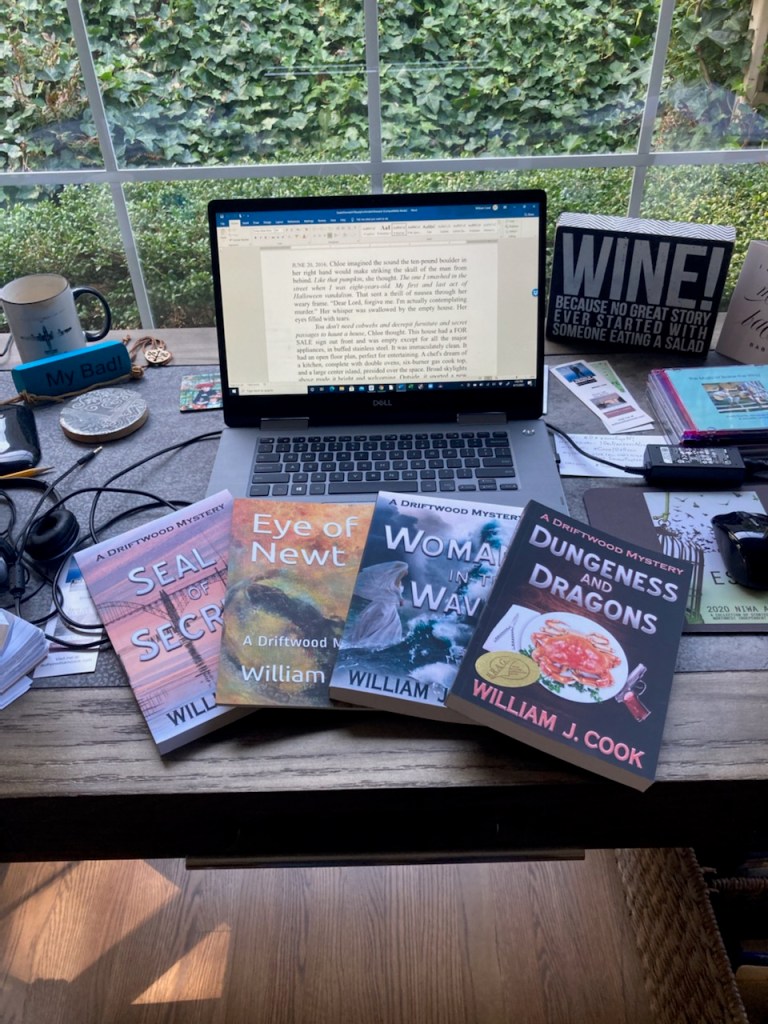
Writing books is fun; promoting them is not. I continue to experiment with marketing strategies. This week, on April 20 and 21, Seal of Secrets will be free and each of the three other books in the Driftwood Mysteries series will be only $0.99. I guess it’s a little like fishing: I cast my line out, using the freebie for bait, and hope to get a bite on the discounted books. My goals are modest, namely, to get more reviews and to earn enough to pay for the promotions. (Of course, the immodest goal is for just that right person to pick up one of my books. You know, the guy with the connections at Netflix and/or Amazon Prime, who says, “Hey, I can make a screenplay out of this!”) Anyway, that’s my version of buying a lottery ticket— the chances of hitting it are considerably less than being struck by lightning on the way to pick up my mail, but so what.

That being said, although the freebie will end after those two days, I’ll continue to discount the others through May 4. I’ve got my fingers crossed for Dungeness and Dragons, which has gotten such good professional reviews and that nifty little gold medallion from indieB.R.A.G.

Meanwhile, work on the short stories is continuing. One has actually morphed into a novelette, about four times longer than the others.

Well, dear friends, that’s my story and I’m sticking to it!

Mybook.to/Driftwood

The Last Update of 2020

Turning and turning in the widening gyre   

The falcon cannot hear the falconer;

Things fall apart; the centre cannot hold;

Mere anarchy is loosed upon the world,

The blood-dimmed tide is loosed, and everywhere   

The ceremony of innocence is drowned;

The best lack all conviction, while the worst   

Are full of passionate intensity.

                                           —The Second Coming, by William Butler Yeats

I don’t know if there is a more perfect poem for 2020. If you haven’t read it in a while, I recommend a re-read. It’s easily available on the Internet and it’s truly riveting.

My intent here is simply to bring families and friends up-to-date on what’s happening in my little corner of the world. Although many good things have happened in my life, I’m almost embarrassed to mention them in the light of all the losses others have suffered. The fires that ravaged the Santiam Canyon left families without homes and sometimes without loved ones. The pandemic has touched the lives of everyone, taking a terrible toll in grief and loss of life. And, of course, politics have been so destructive of anyone’s peace of mind.

That said, my family has been blessed and I am very thankful. My writing has taken a different turn. I spent a lot of time this year doing free promotions, which resulted in more sales than I’ve ever had before, as well as many more reviews and ratings on Amazon. In addition, for the first time I solicited “professional reviews”—those done by experts in the field who work for a fee and never guarantee that the review will be positive. I’ve submitted my latest novel, Dungeness and Dragons, which I published in April, to Kirkus Reviews and US Review of Books. I’ve used one-sentence excerpts from them for “Editorial Reviews” on the book’s Amazon page. Click on those names if you’d like to read the full reviews.

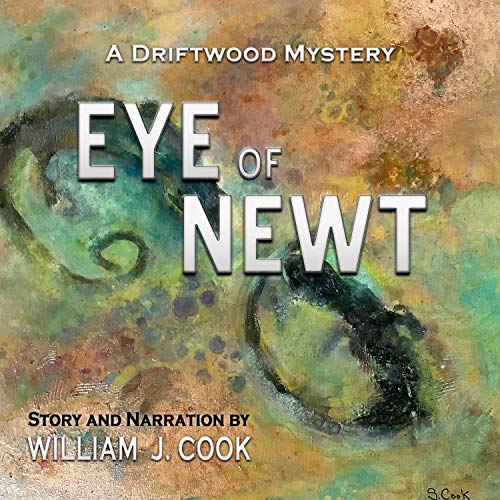
The other news is that my narration of my short story, Eye of Newt, finally got released as an audiobook this week. It’s a hoot to go to the book’s page on Amazon, click the “Sample,” and listen to my own voice! The book is a little less than an hour long, and I have to admit, it was a pretty torturous process doing it. I have way more respect for audiobook producers now!  Will I try to tackle a full-length novel, which would probably be ten times the work I put into this little project? Maybe it’s a tiny bit like the woman who has just given birth saying “Never again!” and then she forgets the pain and has another child. We’ll see. If you’d like to check out that sample I mentioned, clicking on the title will take you there.

Finally, I’ve begun work on another volume of short stories, which I hope to publish in the spring—a little “cleansing of the palate” before I dive into the next Driftwood Mystery. Whitehorse has to do something about Volkov!

So that’s the news for now. I sincerely wish you all the blessings of this holiday season, and health for the New Year.

A Teaser for the New Novel

I’m still hoping to publish Dungeness and Dragons by the end of April. Here’s the first chapter:


1. The Wreck of the Johnny B. Goode


MONDAY, JANUARY 7, 2019. The first storm of January had begun in earnest. Although the sun had not appeared all week, today the roiling black clouds seemed to suck even the faint remaining light from the late afternoon sky, creating a premature twilight. In the darkness, the twelve-foot swells were liquid mountains, rushing headlong toward them, indifferent to the boat bobbing on the surface, unforgiving of any mistakes the three-man crew might make. Even with the howl of the wind and the slashing of the rain, the men could hear the whistler buoy astern, moaning like the soul of a drowned fisherman.

“Are we having fun yet?” Derek Lea shouted to his crew mate Rick Perrins over the roar of the wind. The rain smacked his bright yellow foul-weather gear with a ferocity that seemed bent on shoving him overboard. Waves thundered over the bow, drenching him with walls of water. His mouth filled with the briny taste of the sea. Even through his layered clothing, the cold was leeching the warmth from his body.

“This is nuts!” his partner yelled back. They could barely hear each other, but each knew what the other was thinking. Long familiarity with the hazards of the Pacific made them almost telepathic. Perrins shivered in the onslaught and spat onto the deck. “What are we doing out here?”

“Earning a living, numb nuts!” He drew his hood tighter over his head.

“There’s gotta be an easier way!”

“Of course there is! But everything else is boring!” With the deft hands of years of practice, Lea gaffed the line from a crab pot resting on the sea bottom in fifty feet of water. He looped it over the block, a circular winch at the end of a stainless steel arm, bent at the elbow over the side of the boat, its hydraulic muscle ready to haul the heavy pot out of the water. The pots or traps were round disks about three feet in diameter and a foot high. Metal grates were wrapped around steel frames, making cylindrical cages. One-way doors on opposite sides of the traps allowed crabs to crawl in toward the bait, but not back out.

He engaged the block. The line tightened and came thrumming in. When the three white marker buoys shaped like artillery shells reached the winch, he flipped them away from the gear and back out into the water. As the pot broke the surface, he hit the lever on the gunwale, and the arm of the block extended upward and swung toward the boat, lifting the pot within easy grasp of the two men.

“Heave ho!” Perrins opened the door on top of the trap and the fishermen spilled its contents into a trough between them. They were greeted by a mass of flailing legs and claws as the Dungeness crabs struggled to right themselves and take shelter. The men tossed the large ones into the hole that dropped into the live tank under the deck. Perrins put a gauge across the shells of the smaller ones to make sure they were of legal size, tossing those too small and any females over the side. In moments, he was attaching a new bait bucket filled with frozen squid and sardines inside the pot. Lea disengaged the line from the block, and the men heaved the trap back into the water. The entire operation took less than two minutes.

“There were some big ones in that bunch!” Lea reached for the boat hook again.

“Current’s getting stronger,” his partner complained. “It won’t be long before it pulls our buoys under and we won’t be able to find them until the tide changes.”

“We’ll fall off that bridge when we come to it. Let’s just get the next one.”

The men had been working the Johnny B. Goode for five years. It was a good ship, 48 feet long with an 18-foot beam, used to rough seas. The large wheel house at the forward end held all the living space, including bunks for the crew and a modest galley. Before launch, 250 crab pots had been carefully stacked in the stern of the craft, the lines for each in serpentine coils on top. The Johnny B. Goode was all business.

The men’s fathers and their grandfathers before them had been crab fishermen, and it was all they knew. “It’s in our DNA,” Lea was fond of saying. Neither had ever given a thought to doing anything else, despite the dangers of their chosen profession. Each was a family man, Lea with two sons, ages 12 and 14, and Perrins with three daughters, 5, 10, and 13. On the upper deck of the wheelhouse sat their skipper, Carl Hamisu, piloting the craft and minding the electronics. He spoke little, but he knew the ocean. Widowed five years before, catching crabs was his way of managing his grief.

Lea stretched over the side of the boat to gaff the line just as the ship rose high on a large swell. His feet slipped on the wet deck. He grabbed for the gunwale and caught himself.

“Don’t talk about falling off just yet, big guy!” Perrins laughed.

“Not funny, wise ass.” He drew the line in, looped it on the block, and engaged the machine. The line grew taut but stopped.

“Shit! It’s sanded!” Strong currents sometimes buried the pots in the sand, making them impossible to retrieve. Played by the gale-force winds, the tight line began to whine like the string of a violin.

“Look out!” Both men averted their faces as the nylon line snapped with a sound like a gunshot. The broken line whistled by them, barely missing Perrins’s face. He had not been so lucky last year, and he still bore a scar on his right cheek as mute testimony to the bite of the line. He gathered the loose cord and threw it on the deck until he could coil it later.

“That’s the fourth one this trip. It’s starting to cost us.”

“What?” shouted Lea. “My teeth are chattering so loud I can’t hear you!”

“You crazy sonofabitch! I’m telling the skipper we need to haul ass back to port. It’ll be pitch dark soon and I hate going over the bar at night.”

“We’ve done it a hundred times. What are you scared of?”

“Not scared. Just trying to be smart. This storm has only just begun. It’s gonna get a whole lot worse before it’s over.”

“Hurry back, buddy. Duty calls.”

Perrins made his way forward to the wheelhouse, slowing down through the worst of the swells to maintain his balance. He climbed the stairs and entered the enclosure, pulling the door closed behind him, relishing the sudden warmth now that he was out of the wind.

Carl Hamisu sat in his chair, his signature captain’s cap perched far back on his head, his eyes riveted to the array of instruments before him. His features were a mixture of Asian and Native American.

“Skipper, we need to beat feet outta here. It won’t be long before we can’t see our buoys anymore, and the storm is only growing stronger.”

Hamisu looked up, nodding his head. “Agreed. New weather report says this howler may reach 65 mile per hour gusts in the next couple of hours. I say we head home and come back out tomorrow.”

“Thanks, Carl. I’ll let Derek know. We’ll stow our gear and batten down the hatches.”

He stepped outside. The frigid cold struck him like an icy slap as he made his way back to his friend. The boat pitched as another wave surged into its bow, and he grabbed the gunwale. The spray soaked him.

“Skipper says we’re going home,” he yelled. “Shut it down.”

“Fine by me. I could use a cigarette and a drink.”

When the deck was secure, the two men went forward into the galley. Once out of the roar of the wind, they could hear each other again. They sat on opposite sides of the small wooden table.

“Your lips are the color of the blueberries my little Dakota picked last summer from our garden.”

“It’s cold enough to freeze the balls off a brass monkey. Let’s goose this heater.”

As the temperature rose, they shed their hooded coats but left on the rubberized pants and boots. Lea grabbed two cigarettes from the pack in the overhead cabinet, lit them both, and handed one to his partner.

“Let’s think warm Hawaiian thoughts.”

Perrins exhaled a large plume of fragrant tobacco smoke as the boat heaved hard to port. “He’s gotta turn this baby fast. Glad he’s so good at it.”

“You and me both.” Lea pulled at the long black beard on his face, wringing water from it. “What I wouldn’t give for three fingers of Irish whiskey right about now.”

“Skipper runs a tight ship. No alcohol while we’re working.”

“I know. Just saying.” He relished the kick of the nicotine after hours without it. “Sure am looking forward to my warm bed tonight. Holly will make me all toasty.”

Perrins smiled and nodded his head. Heidi would do the same for him. Friends often asked them if it was strange being married to sisters, but each had always denied it. Instead, it seemed to make their own friendship stronger. “A hot shower first. Wash this ocean off of me.”

“Amen, brother.”

Suddenly, Perrins leaped from his bench. “What was that?”

“What?”

“That…nothing.”

And then Lea heard it, too. The absence of the constant drone of the diesel engine, the sound to which each had grown so accustomed that it only drew attention to itself when it stopped.

“The goddamn engine quit! Christ almighty!”

They ran from the galley to the upper deck. They found Hamisu frantically scrambling over the electronics, searching for the cause of the failure, trying to get the diesel restarted. “Get on the horn to the Coast Guard! Now!”

Perrins picked up the radio. “May Day! May Day! Johnny B. Goode. Engine died.” He looked toward the Skipper. “Where are we at?”

“Just outside the Driftwood Bar.”

“We’re just off the Driftwood Bar,” he called into the radio. “Need help fast.”

Johnny B. Goode, this is Coast Guard Cutter Thomas Jefferson. We are just off your stern. Get you pronto. Hang tight.”

Perrins put the radio down. “Hang tight, he says? Hang tight? If we turn broadside in this shit, we can kiss our sorry asses goodbye!”


Aboard the Thomas Jefferson, Captain John Hartford was barking orders. He ran his hand over the charts spread before him. His face screwed into a frown. “Regents, get outside with the lights and see what we’ve got. Brady, keep your eyes on the radar. If their engine is down, they have only minutes.”

“Skipper, what are those damn fools doing out on a night like this? Jesus!”

“I know Carl Hamisu. He’s a good man. He must have his reasons. But he’s too careful to let his engine die on him. That’s what I don’t understand. He’s been around this ocean a lot more years than I have.”

On the deck, Regents tried to peer through the wind-swept curtain of rain, made dazzling by the bright glare of the search lights. He could just make out the fishing boat ahead, a dark shape bobbing helplessly in the onslaught. He held tight to the rail as the cutter crashed through the waves toward the crippled vessel. The wind and the waves and the rain shrieked in protest.

“Shit! Shit! Shit!” Regents shouted. In the glow of the lights, he caught the shadow of a massive wave bearing down on the Johnny B. Goode. The mountain of moving water pounced over the bow of the hapless boat, flipping it broadside like a toy. With an animal roar, it rolled the boat over and swallowed it.

Regents clambered back inside as quick as a cat. “She’s capsized, Sir! Took one amidships and went over!”

“Sweet Mother!” The Captain wiped the sweat from his brow and took the measure of his men. “OK, every man we can spare, get out there now. Get all our lights on her. Find those men! Carlson, you hold us steady.”

The men scrambled out into the storm. Hartford did a quick mental calculation of how long a man could survive in 49-degree water before lethal hypothermia snatched his life. And that didn’t take into account waves that could gobble a man whole. He cursed under his breath. How long before they could no longer call this a “rescue” operation?

Sometimes he hated his job.


The next day, the sun briefly peeked through the cloud cover at the horizon before disappearing again, but the sky remained an eggshell white, nothing like the inky black of the day before. As ferocious as the storm had been, it was gone by morning, leaving only its unquiet sea behind. Ten-foot swells rolled toward the shore in a lazy, regular rhythm. The wind had died to a mere breeze, barely able to keep the scrounging seagulls aloft. Their cries were a welcome greeting after the howling crescendo of yesterday. The beaches were swept clean, with the exception of a few great logs half-buried in the sand.

Alongside the bay, a bearded cameraman and a young female reporter in a hooded red overcoat were setting up shop. A 4:00 A.M. tip to the newsroom in Portland had sent them scrambling to the little seaside town for the story.

“Hurry, Barry. It’s almost time. How do I look?”

“Laurel, you look little red riding hood, only cuter. Now let me concentrate on this equipment.”

The woman touched her earpiece. “Here they come. Are we ready?” She saw the red light on the camera and looked into the lens. “Good morning, Julie. I’m standing here by the bay in Driftwood, in front of two rows of upright pylons, all that’s left of the Driftwood boardwalk after it was destroyed by the famous fire of 1967. Now look behind me. Just look what yesterday’s storm did.”

The camera panned around behind the reporter. A small group of early morning beachcombers were staring upwards.

Impaled like a giant insect on one of the stanchions of the burned-out boardwalk was the Johnny B. Goode. A pillar had pierced its hull and protruded above the main deck, just aft of the wheelhouse.

“The Coast Guard reports that this commercial crabbing boat, the Johnny B. Goode, capsized last night in heavy seas and was hurled up here into the bay by the storm surge. The rescue boat Thomas Jefferson was unable to reach them in time. The body of the fishing boat captain, Carl Hamisu, was found on the beach this morning by a woman walking her dog. The crewmen, Derek Lea and Rick Perrins, have not been found, but are presumed dead.”

The camera returned to the reporter’s face.

“The tight-knit community of Driftwood is mourning the tragic loss of favorite sons, heads of families who had made their livelihoods here over several generations. They were well-known and well-liked, and two of the men leave behind grieving widows and young children. If you’ll come with me now, we’ll speak with some of the people who are beginning to gather here.”

She turned and walked toward the group near the water’s edge, her cameraman following dutifully behind. As she approached, two men separated themselves from the group and began to walk away. Both were wearing knit caps pulled over their ears against the cold. She found it difficult to determine their ages, since the faces of both looked leathery, etched by long exposure to wind and weather. One had a long black beard beginning to show streaks of gray. The other was clean-shaven. She thought they might be brothers.

“Excuse me,” she called, as she extended the microphone before her. “Please wait. Did you know these men?”

Both looked uncomfortable, unwilling to speak. After a moment of silence, the bearded one said, “Yes, we knew them. Good men. Tragic. Tragic what’s happened. They shouldn’t have gone out in that storm.” He swung his head in both directions, reminding her of an animal in a live trap, looking for an escape. As other people from the small crowd drew near, the two men slipped away.

“We knew them,” a woman hollered, raising her hand to be seen above the others. “Good men. Good families. Terrible loss.”

The newswoman returned to the camera. “I’ve been told that Darby Gallaway, owner of the local Reef Coffee Shop, will be starting a GoFundMe page to benefit the stricken families. Memorial services are being planned for later in the week.

“Now back to you, Julie.”

As he turned off the camera and lowered it, Barry said, “Nice job, hon. Shall we interview some of the others for the evening spot tonight?”

Laurel pulled some gloves from her pocket and put them on. “Good idea. That woman in the crowd seemed pretty eager to talk. Then we’ll walk around the town and take a look. Driftwood’s been out of the news since that club fire last year. What was it? Chaos? Anyway, let’s see if there’s been any changes.” As she turned back to the onlookers, she whispered, “Let’s milk this story for all it’s worth.”


The New Audiobook is Here

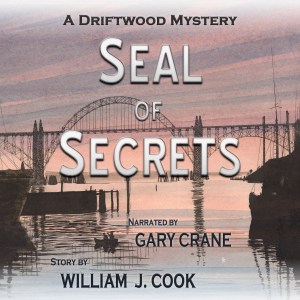
At last! Gary Crane and I have finally given birth to the audiobook version of Seal of Secrets. It’s been an enlightening and engaging experience, to say the least. I am so curious to see what happens next. Will people like it enough to buy it? Although I will be simply delighted to earn back my initial investment, I have to confess that I have my own personal “winning the lottery” scenario: that phone call or email that says, “Mr. Cook, we’re interested in optioning your property for a screenplay…” Oh, yeah! But I haven’t even been struck by lightning, so I’m not sure of the odds of that happening. I guess you can’t blame an old guy for dreaming!


Upcoming Audiobook

Those of you who follow me on Facebook have heard the news that Seal of Secrets is being made into an audiobook that will be available on Amazon, Audible, and iTunes by mid-to late June. It will be narrated by Gary Crane. Here’s his website. My cover designer, Roslyn McFarland, of Far Lands Publishing, (farlandspub@gmail.com) has taken Margaret S. Tsang’s original painting, “Yaquina Sunrise”) and made it into the cover for the new version. Yes, it takes a village to make a book!


Thoughts About Writing a Novel

I’m one month away from publishing my next novel and it got me thinking about how I got here. Although I had written a novel and two-thirds of another back in the 80’s, their drafts sit gathering dust in a closet. I began writing in earnest when I retired at the end of 2011. And here I am, with two novels, two books of short stories, and soon a third novel.

I’m beginning to think that writing, like raising children, takes a village. Where would I be now without the help of people in the Northwest Independent Writers Association–Roslyn McFarland, Jennifer Willis, Jamie McCracken, Lee French, Pam Cowan, Jonathan Eaton, April Aasheim, Larry Powers, among others? Or friends at Goodreads, including Ginger Bensman, David Rose, Michael Gardner, and others? My monthly critique group, the Salem branch of Willamette Writers, and the weekly library group, Writers Yesterday, Today, and Tomorrow are also a part of the community that supports me.

The gestation period of my new novel is just about nine months to the day. I’m giving birth again, this time on Halloween! Who woulda thought? And it began in the early days of last February with a simple incident: I went hunting for agates with my daughter’s family on the Oregon coast. That’s all I knew–I had no outline for a story, no idea where it was going to go, no plot. I just wrote about a man trying to find agates, all the while keeping a wary eye out for sneaker waves. Then I found out he was a widower and a college professor. Shortly after that, I discovered he knew the college professor who had committed murder in my short story “Eye of Newt.” Oh my goodness! I hadn’t seen that coming! But that’s how it grew. And I realized that the murderer had to get his comeuppance after escaping the clutches of Officer Whitehorse in the short story. After all, I couldn’t help but remember Alfred Hitchcock assuring his audience that crime doesn’t pay just after the troubled housewife who had murdered her husband with a frozen leg of lamb roasts it and serves it to the policemen investigating the case!

So there we are. I’m pleased with the way the novel came out, and I’m very happy with the cover. I hope it keeps you up reading way past your bedtime!

Here’s the link to pre-order it: Woman in the Waves.